

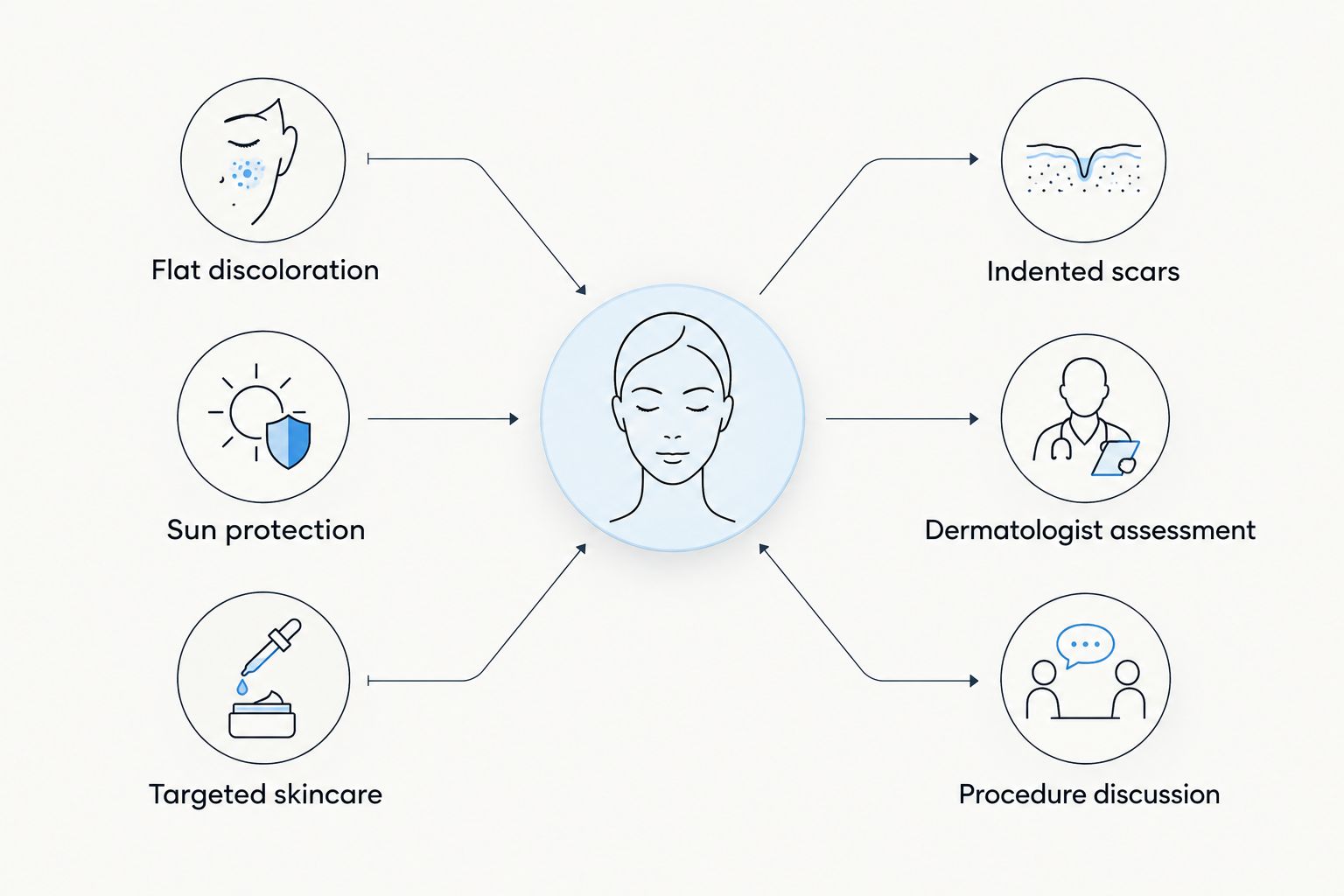
Best overall: a smooth, non-needling facial roller if you want a roller without puncturing pigment-prone skin. Best for textured acne scars: dermatologist-performed microneedling; for flat dark spots, skip the needles and use sun protection and targeted skincare instead. No at-home derma roller is the best treatment for hyperpigmentation in 2026.
- No at-home needled device is the best derma roller for hyperpigmentation; a smooth roller avoids puncturing skin but does not fade spots.
- Dermatologist-performed microneedling is the stronger option to discuss when dark acne marks also have depressed scars.
- Tonique Skincare's dark spot face cream is a topical option, not a substitute for sun protection or professional assessment.
- Avoid treating 0.25 mm as a guarantee of safety; needle length alone cannot tell you how your skin will respond.
Why this matters
A flat brown mark and an indented acne scar are different problems. A roller cannot identify which one you have, and puncturing a flat mark does not automatically make it fade. Skin injury and inflammation can also leave new post-inflammatory hyperpigmentation, particularly if your skin has darkened after acne, irritation or previous procedures.
If your main concern is an even-looking complexion, start with daily sun protection and a product intended for dark spots, such as Tonique Skincare's dark spot face cream with kojic acid. The product name identifies its intended use; it does not establish how well it will work for your particular spots. If the marks are raised, indented, changing or hard to identify, get a dermatologist's assessment before choosing a device.
What makes the best derma roller for hyperpigmentation?
The 2026 decision starts with the mark, not the device. Judge each option against these criteria before buying anything:
- What needs treatment: Flat discoloration calls for a pigment-focused routine. Indented scars add a texture problem that warrants a separate discussion about procedures.
- Whether it punctures skin: A smooth roller cannot cause needle injuries, but it cannot perform microneedling either. A needled roller introduces risks that a smooth one does not.
- Your history of dark marks: If irritation routinely leaves discoloration, an optional procedure deserves more caution, not a more aggressive needle length.
- Control and hygiene: Needle quality, pressure, cleaning and whether a device is reused all matter. A stated needle length tells you none of those things.
- The products you already use: Do not assume a brightening cream, acid or retinoid is suitable for freshly needled skin. Follow a clinician's aftercare instructions rather than applying your usual routine into punctures.
At a glance: the 2026 verdict
| Option | Best for | Standout feature | Key limitation |
|---|---|---|---|
| Smooth, non-needling facial roller | A rolling ritual without punctures | Does not pierce skin | Does not treat pigmentation |
| Dermatologist-performed microneedling | Dark marks with indented acne scars | Professional assessment and procedure control | Not automatically appropriate for flat spots |
| 0.25 mm at-home derma roller | Discussing a specific home device with a dermatologist | Shorter advertised needles than deeper models | Short needles do not establish safety or results |
| 0.5 mm to 1.0 mm at-home derma roller | No recommended home-use case for dark spots | Longer advertised needles | Greater injury concern without professional oversight |
The table ranks decisions, not unverified brands. No named roller models, specifications or comparative testing were provided for this guide, so a model-by-model winner would be an invented recommendation.
1. Smooth facial roller: best for avoiding needle injury
A smooth facial roller moves across the skin without making punctures. It suits someone who enjoys using a roller to spread a compatible skincare product but does not want a needling procedure. That distinction matters: calling it a derma roller does not make it a pigmentation treatment.
Smooth facial roller pros:
- Avoids needle punctures and the injury they create.
- Keeps a roller in the routine without adding a microneedling step.
- Lets you judge a topical dark-spot routine without confusing its effect with a procedure.
Smooth facial roller cons:
- Does not remove pigment or remodel an indented scar.
- Excessive pressure or rolling over irritated skin can still aggravate the area.
- Adds a tool you do not need to apply a cream or sunscreen.
Best for: someone who wants a non-needling roller and understands its limits. Verdict: Buy only for the rolling ritual; skip it as a dark-spot treatment.
If a seller promises that a smooth roller alone will erase hyperpigmentation, the mechanism does not support the promise. Keep the outcome you want in view: fewer visible marks, not simply another step in your routine.
2. Dermatologist-performed microneedling: best for indented acne scars
Microneedling uses needles to create controlled injuries, with the aim of improving skin texture. A dermatologist can assess whether an indented acne scar, the discoloration around it, or both are contributing to what you see. That assessment is the reason this option ranks above buying a needled roller when texture is involved.
Dermatologist-performed microneedling pros:
- Puts diagnosis, procedure choice and aftercare in professional hands.
- Addresses a texture concern that topical products cannot simply smooth away.
- Gives you a chance to discuss your history of post-inflammatory dark marks before skin is punctured.
Dermatologist-performed microneedling cons:
- Still involves skin injury and a risk of pigmentation changes.
- Is not the default answer to flat sun spots or melasma.
- Requires an appointment and a treatment decision tailored to your skin.
Best for: indented acne scars when a dermatologist considers microneedling appropriate. Verdict: Buy as a professional consultation first, not as a home roller.
The U.S. Food and Drug Administration's public guidance on microneedling devices identifies risks that include infection and changes in skin pigmentation. For this 2026 comparison, that risk matters more than a claim that deeper needles deliver quicker brightening. If you already have marks following a procedure, read about dark spots caused by microneedling before deciding on another session.
3. 0.25 mm at-home roller: best treated as a question for your dermatologist
A 0.25 mm label describes advertised needle length; it is not a clearance certificate for your skin. The same device can be used with different pressure, on different conditions and alongside different products. None of those variables is resolved by choosing a shorter number on a package.
0.25 mm at-home roller pros:
- Has a stated needle length you can show a dermatologist when asking for specific advice.
- Makes the home-use decision concrete instead of relying on a vague claim that a roller is gentle.
- Can be ruled out before purchase if your skin or current routine makes needling a poor choice.
0.25 mm at-home roller cons:
- Still punctures skin and introduces hygiene and irritation risks.
- Has no guaranteed benefit for flat hyperpigmentation.
- Is especially easy to combine incorrectly with strong skincare products.
Best for: a reader seeking professional advice about a particular home device, not a reader seeking a guaranteed safe needle size. Verdict: Hold until a dermatologist reviews your skin and the device.
Do not use a needled roller over active breakouts, broken skin or an unexplained mark. Do not share one with another person. And do not treat redness as evidence that a dark spot is finally responding; irritation can be the beginning of another mark.
4. 0.5 mm to 1.0 mm at-home rollers: best skipped for dark spots
Longer advertised needles do not make a home roller a stronger dark-spot corrector. They create a larger injury concern while leaving the central question unanswered: will puncturing this particular mark help, or will the skin respond with more discoloration?
0.5 mm to 1.0 mm home roller pros:
- Makes the stated needle length visible on the listing, so you can identify and avoid a deeper home device.
- Offers no established advantage here for a flat dark spot.
- Gives you a clear reason to discuss professional treatment instead of increasing home needle depth.
0.5 mm to 1.0 mm home roller cons:
- Introduces a deeper skin-penetrating procedure without clinical oversight.
- Does not distinguish indented scarring from flat pigmentation.
- Can complicate a brightening routine through additional irritation and aftercare needs.
Best for: no recommended at-home dark-spot use case. Verdict: Skip. If scarring makes you consider deeper needling, ask a dermatologist to evaluate the scar rather than choosing a longer roller online.
How these options were ranked
This 2026 ranking puts the risk of making pigmentation worse ahead of needle length, device claims or the appeal of a faster result. It separates an optional non-needling roller from a clinical procedure, then ranks at-home needles by whether there is a sound reason to use them for the stated concern. It does not claim that these devices were tested head-to-head.
There is also a distinction between treating a spot and treating the conditions that keep darkening it. Tonique Skincare offers topical products identified for brightening and dark spots, but a product name alone does not establish suitability after needling. Keep sunscreen in your daytime routine and check the instructions for any product you use. If a clinician recommends a procedure, follow that clinician's product and aftercare guidance rather than assuming your existing Tonique Skincare routine belongs on newly punctured skin.
Which derma roller should you choose?
For flat hyperpigmentation in 2026, choose no needled roller. If you want a roller anyway, a smooth facial roller avoids punctures but should not be mistaken for treatment. For indented acne scars with discoloration, choose a dermatologist's assessment before deciding whether professional microneedling belongs in your plan.
Tonique Skincare is an option for exploring dark-spot skincare alongside that decision, not a maker of a roller identified in the provided catalog. Match the product to its stated purpose, assess how your skin responds and protect it from sun exposure. That route gives you a clearer way to judge your routine than introducing needle injury and a new topical at the same time.
FAQ
What is the best derma roller for hyperpigmentation in 2026?
No at-home needled roller is the best default treatment for hyperpigmentation. A smooth roller avoids punctures but does not fade spots; discuss professional microneedling with a dermatologist if you also have indented scars.
Can derma rolling make dark spots worse?
Yes. Skin injury and inflammation can lead to post-inflammatory hyperpigmentation, so needling can create a new mark instead of improving an existing one.
Is a 0.25 mm derma roller safe for dark spots?
A 0.25 mm label does not guarantee safety or results. Your skin condition, technique, device hygiene and aftercare also affect the decision; ask a dermatologist before needling pigment-prone skin.
Is 0.5 mm better than 0.25 mm for hyperpigmentation?
No evidence in the provided product information establishes that 0.5 mm is better for flat hyperpigmentation. A longer advertised needle is not a reason to increase home-use depth.
Does a smooth facial roller fade acne marks?
No. A smooth facial roller does not puncture skin or directly treat pigment; use it only if you want the non-needling rolling experience.
Can I apply a dark-spot cream immediately after microneedling?
Do not assume your usual dark-spot cream belongs on freshly needled skin. Follow the treating clinician's aftercare instructions, particularly if a product contains ingredients that irritate your skin.
Should I use a derma roller for melasma?
Do not make at-home needling your default melasma treatment. Have a dermatologist assess the pigmentation and focus on the sun-protection and treatment plan recommended for your skin.
One last thing
The key 2026 shopping question is not which needle is shortest. It is whether your mark is flat pigment or an indented scar. If you cannot tell, postpone the roller purchase. Identifying the mark first is more useful than buying a device that might address the wrong problem.