

Best overall: a fragrance-free niacinamide serum at 2% to 5%. Best for redness: niacinamide with panthenol. Best budget option: the lowest-cost fragrance-free 5% serum with a clear ingredient list. This 2026 guide compares six formula types and explains how to layer niacinamide, including how to combine niacinamide and vitamin C without irritation.
- Tonique Skincare picks fragrance-free 5% formulas as the best niacinamide serum for sensitive skin in 2026.
- Choose panthenol for redness, humectants for dryness, and zinc PCA for oily, acne-prone skin.
- Patch-test twice daily for 7 to 10 days before applying a new serum across your face.
- Skip fragrance and strong exfoliating acids when your skin barrier already feels irritated.
Why this matters
Niacinamide supports the skin barrier and can improve the appearance of uneven tone, dark spots and visible redness. Sensitive skin can still react to a niacinamide serum when the concentration is high, the formula contains fragrance or several active ingredients are introduced together.
The percentage on the bottle is only one part of the decision. A simple 5% serum can be easier to tolerate than a complex 2% formula containing fragrance, essential oils or exfoliating acids. Tonique Skincare evaluates niacinamide serum types by the complete formula rather than treating a higher percentage as automatically better.
For 2026, the strongest default is simple: start with one moderate-strength serum, patch-test it and keep the rest of your routine stable. That approach makes it easier to identify the cause if burning, persistent redness or swelling develops.
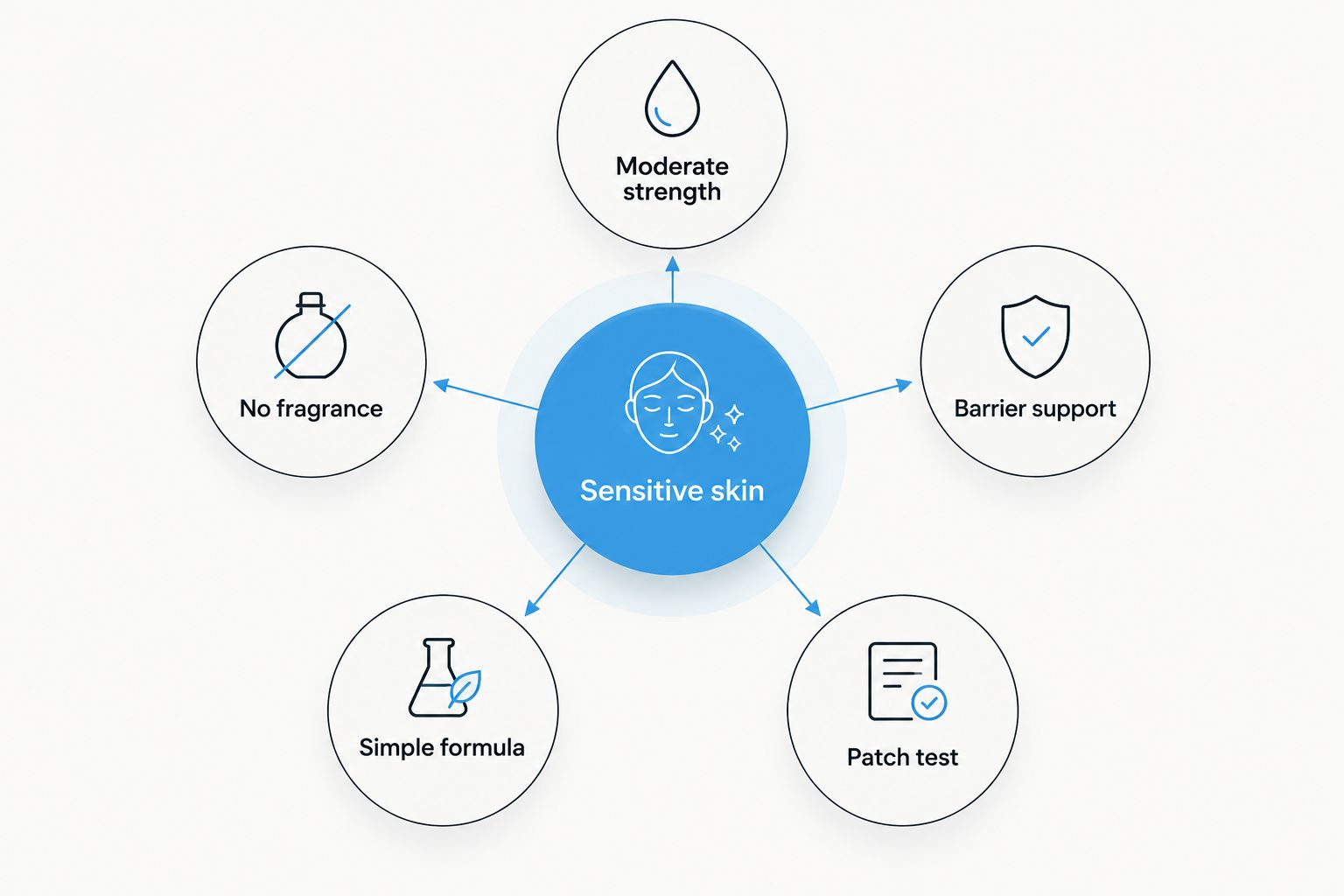
What makes the best niacinamide serum for sensitive skin
- Moderate strength: Start between 2% and 5% instead of assuming a 10% formula will work faster or better.
- No fragrance: Avoid added fragrance and essential oils when your skin already reacts easily.
- Barrier support: Panthenol, glycerin and hyaluronic acid can make a niacinamide formula more suitable for dry or sensitized skin.
- Simple formula: A serum containing several acids, retinoids or acne actives creates more possible sources of irritation.
- Clear directions: Choose a label that states the niacinamide percentage and explains how often to apply the product.
- Patch test: The American Academy of Dermatology advises testing a skincare product on a small area twice daily for 7 to 10 days.
Best niacinamide serum types at a glance
Tonique Skincare's 2026 verdict: a fragrance-free 5% niacinamide serum is the best default for sensitive skin because it balances published evidence with a manageable active concentration.
| Rank | Serum type | Best for | Standout feature | Key limitation |
|---|---|---|---|---|
| 1 | Fragrance-free 5% niacinamide | Sensitive skin overall | Moderate active concentration | Can still irritate a damaged barrier |
| 2 | Niacinamide with panthenol | Redness-prone skin | Adds barrier support | More ingredients to patch-test |
| 3 | Niacinamide with humectants | Dry, flaky skin | Combines tone care with hydration | Does not replace moisturizer |
| 4 | Niacinamide with zinc PCA | Oily, acne-prone skin | Suits oil-focused routines | Is not an acne treatment |
| 5 | Minimalist niacinamide | Highly reactive skin | Short ingredient list | Fewer supporting ingredients |
| 6 | Lowest-cost fragrance-free 5% serum | Budget-conscious beginners | Tests tolerance without a complex formula | Bottle size and formula quality vary |
1. Fragrance-free 5% niacinamide: best overall
A fragrance-free 5% niacinamide serum is the best starting point for most sensitive skin in 2026. A peer-reviewed split-face study published in 2005 evaluated 5% topical niacinamide over 12 weeks and reported improvements in several visible signs of facial aging, including blotchiness.
The concentration still does not guarantee tolerance. Check the complete ingredient list, and avoid starting the serum while your skin is sunburned, peeling or reacting to another product.
Fragrance-free 5% niacinamide pros:
- Uses a moderate concentration supported by published cosmetic research
- Avoids fragrance as an unnecessary variable
- Fits into morning or evening routines
- Can target uneven-looking tone without exfoliating the skin
Fragrance-free 5% niacinamide cons:
- Can sting when the skin barrier is already damaged
- Does not replace moisturizer or sunscreen
- Requires consistent use rather than occasional spot application
Best for: sensitive-skin beginners who want one clear default. Verdict: Buy.
2. Niacinamide with panthenol: best for visible redness
Panthenol, also called provitamin B5, is a humectant and skin-conditioning ingredient. Pairing it with niacinamide gives redness-prone skin a formula focused on barrier support rather than exfoliation.
This type suits skin that becomes tight or visibly red after cleansing. It does not treat rosacea, and persistent facial redness still needs assessment by a qualified clinician. Tonique Skincare's guide to niacinamide serum for rosacea and redness explains how to keep the surrounding routine simple.
Niacinamide with panthenol pros:
- Combines niacinamide with a non-exfoliating humectant
- Suits routines built around barrier support
- Avoids adding another strong active solely for redness
Niacinamide with panthenol cons:
- Does not replace medical treatment for rosacea
- Creates more ingredients to evaluate during a patch test
- Some humectant-rich formulas feel tacky under makeup
Best for: sensitive skin affected by dryness and visible redness. Verdict: Buy.
3. Niacinamide with humectants: best for dry, flaky skin
Look for glycerin, hyaluronic acid or panthenol alongside niacinamide when dryness is the main problem. These humectants attract water, while a moisturizer applied afterward helps reduce moisture loss from the skin surface.
A serum cannot provide every part of a dry-skin routine. Very dry skin still needs a moisturizer, and sunscreen remains necessary during the day. Applying a humectant serum to slightly damp skin can also make it easier to spread without rubbing sensitive areas repeatedly.
Niacinamide with humectants pros:
- Addresses dehydration and uneven-looking tone in one step
- Sits comfortably beneath a separate moisturizer
- Avoids relying on exfoliation to make flaky skin look smoother
Niacinamide with humectants cons:
- Does not provide the occlusive layer very dry skin needs
- Humectant-heavy formulas can feel sticky
- Added botanical extracts can complicate an otherwise gentle formula
Best for: dry, tight or flaky sensitive skin. Verdict: Buy.
4. Niacinamide with zinc PCA: best for oily, acne-prone skin
Niacinamide and zinc PCA commonly appear together in serums positioned for oily skin. This pairing can fit a routine focused on shine and post-breakout discoloration without adding an exfoliating acid to the same step.
Do not treat the serum as a replacement for acne care. Painful, deep or scarring breakouts need more than a cosmetic niacinamide formula. The guide to niacinamide serum for acne-prone skin covers routine placement in more detail.
Niacinamide with zinc PCA pros:
- Fits oily and acne-prone skincare routines
- Avoids combining niacinamide with an acid in one serum
- Can address the appearance of post-breakout marks
Niacinamide with zinc PCA cons:
- Is not a treatment for moderate or severe acne
- Can feel drying when paired with astringent ingredients
- May pill when too many silicone-rich layers are applied
Best for: sensitive skin that is also oily or prone to clogged pores. Verdict: Buy.
5. Minimalist niacinamide: best for highly reactive skin
A minimalist serum uses a short ingredient list with niacinamide, a solvent, basic humectants and the preservatives needed to keep the formula usable. Fewer ingredients do not guarantee a reaction-free experience, but they make it easier to isolate what your skin does not tolerate.
Check the label rather than trusting the front of the package. Terms such as clean, natural and hypoallergenic do not tell you the niacinamide concentration or identify every possible irritant.
Minimalist niacinamide pros:
- Reduces the number of ingredients introduced at once
- Makes patch-test results easier to interpret
- Fits routines that already contain moisturizer and sunscreen
Minimalist niacinamide cons:
- Offers fewer barrier-supporting ingredients
- Simple formulas can still contain an ingredient you cannot tolerate
- May require separate products for dryness or active breakouts
Best for: highly reactive skin and anyone rebuilding a stripped-down routine. Verdict: Buy after patch-testing.
6. Lowest-cost fragrance-free 5% serum: best budget option
The best budget choice is not automatically the bottle with the lowest shelf price. Compare the niacinamide percentage, bottle size, ingredient list and application directions before deciding which formula offers the better fit.
Choose a fragrance-free 5% option over a cheaper 10% serum packed with extra actives. Sensitive skin gets little value from a product that cannot be used consistently.
Budget niacinamide serum pros:
- Provides a lower-commitment way to test niacinamide
- Can match the concentration of more elaborate formulas
- Leaves room in the routine for moisturizer and sunscreen
Budget niacinamide serum cons:
- A smaller bottle can make the lowest shelf price misleading
- Product formulas can change, so the ingredient list needs rechecking
- Basic formulas may lack supporting humectants
Best for: beginners who want a simple tolerance test before refining the routine. Verdict: Hold until the label passes the same criteria as the overall winner.
How to introduce niacinamide without overwhelming your skin
Patch-test the serum before full-face use. Apply it to a small area twice daily for 7 to 10 days, following the American Academy of Dermatology's general product-testing guidance. Stop if you develop swelling, blistering, intense itching or persistent burning.
After a successful patch test, use the serum on clean skin and follow with moisturizer. Start with one daily application rather than introducing morning and evening use immediately. Keep acids, retinoids and other new treatments out of the routine during this adjustment period so you can identify the source of any reaction.
Once your skin is comfortable, niacinamide can sit alongside other brightening ingredients. Introduce only one change at a time. Sunscreen belongs in the morning routine because new and existing discoloration can become more noticeable with ultraviolet exposure.
How the 2026 ranking works
The ranking gives the first position to the formula type that fits the widest sensitive-skin audience. Lower positions solve narrower problems such as redness, dryness, oiliness, ingredient reactivity or budget limits.
Concentration, fragrance, active load, barrier-support ingredients and label clarity carry more weight than packaging claims. A high percentage does not win by default, and a sensitive-skin label does not excuse fragrance or an overloaded ingredient list.
Which niacinamide serum should you choose?
Choose a fragrance-free 5% niacinamide serum if you remain undecided in 2026. Pick a panthenol pairing for visible redness, a glycerin or hyaluronic acid pairing for dryness, or a zinc PCA pairing for oily, acne-prone skin.
Tonique Skincare recommends treating the niacinamide serum as one part of a brightening routine rather than stacking several aggressive products at once. The default decision is a moderate-strength, fragrance-free serum followed by moisturizer and daytime sunscreen.
FAQ
What is the best niacinamide serum for sensitive skin in 2026?
A fragrance-free niacinamide serum at 2% to 5% is the best default for sensitive skin in 2026. Choose a simple formula and patch-test it before full-face use.
Is 10% niacinamide too strong for sensitive skin?
A 10% niacinamide serum can be more than sensitive skin needs. Start between 2% and 5%, then judge tolerance before considering a stronger concentration.
Can sensitive skin use niacinamide every day?
Sensitive skin can use niacinamide daily when the formula is tolerated. Begin with one application per day and reduce frequency if persistent stinging or redness appears.
How do you patch-test a niacinamide serum?
Apply the serum to a small test area twice daily for 7 to 10 days. Do not use it across your face if the test area develops swelling, intense itching or persistent burning.
Can you use niacinamide and vitamin C together?
Niacinamide and vitamin C can be used in the same routine. Sensitive skin should introduce one product first, confirm tolerance and then add the second product.
Can you use niacinamide with retinol?
Niacinamide and retinol can share a routine, but introducing both at once makes irritation harder to trace. Establish tolerance to one product before adding the other.
How long does niacinamide take to improve uneven-looking tone?
Niacinamide requires consistent use, and published cosmetic studies commonly assess results over several weeks rather than several days. A 2005 study of 5% niacinamide evaluated facial changes over 12 weeks.
Does niacinamide cause skin purging?
Niacinamide is not an exfoliating acid or retinoid, so it is not expected to cause classic skin purging. New bumps, burning or redness can indicate irritation from the formula instead.
One last thing
The front label matters less than the complete ingredient list. In 2026, sensitive-skin shoppers should reject the idea that a 10% or higher concentration automatically produces a better brightening result. A moderate formula you can apply consistently beats a stronger serum that leaves your skin inflamed.