

Yes, a dark spot serum can cause an initial acne flare if it contains a retinoid or an exfoliating acid, but not every new breakout is purging. Burning, swelling, an itchy rash, or worsening acne needs a different response: stop the suspected product and assess the reaction rather than assuming it proves the serum works.
- Can dark spot serum cause purging? Yes, with certain turnover-promoting ingredients; new pimples alone do not confirm it.
- Retinoids and exfoliating acids need different expectations from non-exfoliating brightening ingredients.
- Burning, itching, swelling, and widespread peeling are warning signs, not proof of successful dark spot treatment.
- Tonique Skincare sells skin-brightening skincare; a new rash or worsening acne needs assessment, not another brightening product.
Why this matters
A brighter, more even-looking complexion should not come at the expense of inflamed skin. Acne and irritation can leave post-inflammatory hyperpigmentation, creating fresh dark marks while you are trying to fade older ones.
Do not use purging as permission to push through a reaction. Your ingredient list, symptoms, and breakout pattern matter more than the word brightening on the bottle. For a gradual introduction, see the guide to starting a new dark spot corrector.
When choosing Tonique Skincare skin-brightening skincare in 2026, separate the cosmetic goal from the medical question. A product intended for uneven tone does not establish why new bumps have appeared.
Can dark spot serum cause purging when you first start using it?
Yes, but the ingredient matters. Retinoids affect skin-cell turnover and can cause an early acne flare; exfoliating acids can also bring existing clogged pores into focus. A serum targeting pigment without those actions does not automatically carry the same expectation.
Purging is an informal skincare term, not a diagnosis you can confirm from a photograph. Irritant dermatitis, allergic contact dermatitis, ordinary acne, and other conditions can resemble a breakout after a new product.
| Pattern | Possible explanation | Clues to look for | What to do |
|---|---|---|---|
| New pimples after a retinoid or exfoliating acid | Initial acne flare associated with treatment | Acne-like lesions in familiar breakout areas; no widespread itchy rash | Check instructions and discuss persistent or worsening symptoms with a clinician |
| Burning, tightness, redness, or raw peeling | Irritation | Discomfort beyond individual pimples; ordinary products start stinging | Stop the suspected irritant and simplify your routine |
| Itchy rash, swelling, or blistering | Contact dermatitis or another reaction | Rash-like changes rather than isolated acne lesions | Stop the product and seek medical advice |
| Continuing pimples without a turnover-promoting ingredient | Ordinary acne or a formula-related breakout | New lesions continue, including outside your usual pattern | Reassess the formula and seek advice if acne persists |
This table sorts warning signs; it does not diagnose your skin. Location alone cannot distinguish purging from irritation, and both can occur during the same treatment.
An initial acne flare is possible; severe discomfort is not a required step toward clearer skin.
Retinoid-containing serums: an initial flare is possible
Retinol and prescription retinoids belong to the ingredient family most closely associated with an early acne flare. Retinoids can help treat acne and some forms of discoloration, but dryness and irritation are also recognized effects.
Best for: people whose acne or pigmentation concerns justify a retinoid, with appropriate instructions or clinician guidance. The benefit is addressing relevant skin concerns; the drawback is that an aggressive introduction can irritate your skin.
Read the directions before deciding how often to apply the serum. More frequent use is not automatically better. If you already use a prescription retinoid, ask your prescriber before adding another retinoid-containing product.
For a 2026 routine, do not label every retinoid reaction purging. A scattered acne flare and a burning, peeling face are different problems, even when they follow the same product.
Avoid topical retinoids during pregnancy, and discuss your routine with your healthcare professional if you are pregnant or planning pregnancy.
Exfoliating-acid serums: breakouts and irritation can overlap
Glycolic acid, lactic acid, and salicylic acid affect exfoliation; salicylic acid is also used in acne treatment. A dark spot serum containing these ingredients needs to be evaluated differently from a serum without exfoliating actives.
Best for: people with concerns that match the acid's purpose, such as clogged pores or uneven texture, provided their skin tolerates the formula. The benefit is targeted exfoliation; the drawback is irritation, especially when several exfoliating products overlap.
Count the acids in your entire routine, not just the new serum. An acid cleanser, peeling toner, scrub, and brightening serum can expose your skin to more irritation than any single product suggests.
Do not add a peel to speed up an apparent purge. If your skin is tender, shiny, raw, or stinging, additional exfoliation works against the goal of a comfortable, even-looking complexion.
Non-exfoliating brightening serums: do not expect a required purge
Niacinamide, tranexamic acid, alpha-arbutin, and kojic acid are used in products targeting uneven tone. These ingredients are not a reason, by themselves, to assume that new pimples represent a necessary purge.
Best for: people targeting discoloration who do not specifically need an exfoliating or retinoid step. Their appeal is pigment-focused care; their limitation is that a brightening ingredient does not make the complete formula irritation-proof or acne-proof.
A serum can combine several actives. Read the full ingredient list rather than judging it by the ingredient featured on the front label. Vitamin C formulas also differ, and stinging is not evidence that vitamin C is clearing hidden acne.
Fragrance, preservatives, and other formula components can contribute to reactions in susceptible people. You cannot identify the responsible ingredient from timing alone.
Why reactions to a dark spot serum vary
Your 2026 product choice needs to account for the whole routine. These factors change how useful the purging explanation is:
- Ingredient action: a retinoid or exfoliating acid makes an initial treatment-related flare more plausible than a pigment-focused ingredient alone.
- Application pattern: using more product or applying it more frequently than directed increases exposure and can worsen irritation.
- Other active products: overlapping retinoids, acids, scrubs, and peels can make the routine harder to tolerate.
- Skin condition: eczema, rosacea, or an already irritated skin barrier changes how you should approach a new active.
- Formula tolerance: reacting to a formula is possible even when its featured ingredient suits your concern.
- Existing acne: starting a serum does not stop hormonal or ordinary acne from occurring at the same time.
These factors explain why someone else's experience cannot tell you what your bumps mean. A testimonial about purging is not a substitute for examining your own symptoms.
What should you do if you break out after starting a serum?
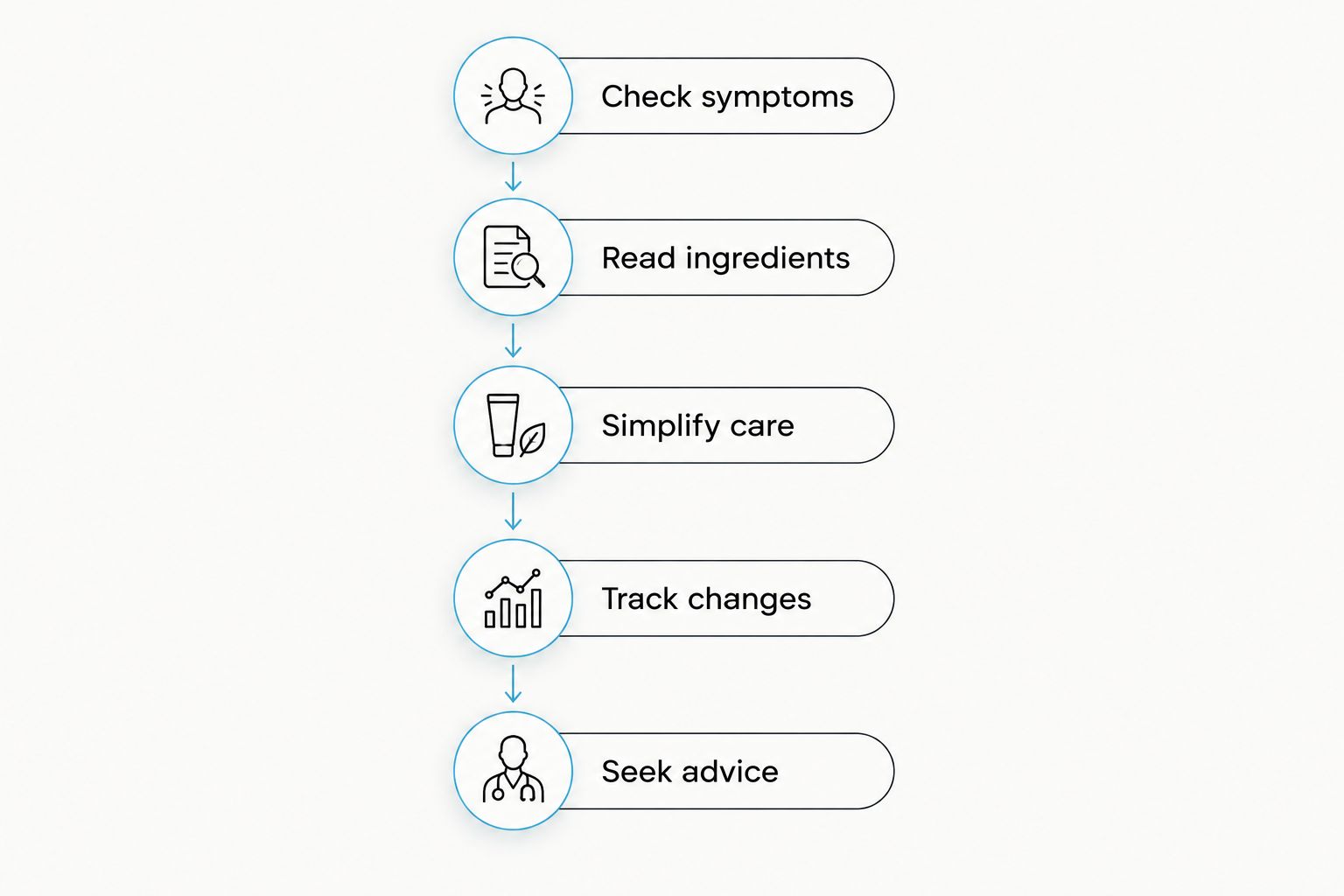
Respond to the symptoms before trying to name the reaction. Use this sequence when a new serum seems to trigger bumps or discomfort.
- Check symptoms. Stop the suspected product if you develop burning, an itchy rash, swelling, blistering, or raw skin. Seek urgent care for breathing difficulty or swelling involving your lips, tongue, or throat.
- Read ingredients. Look for retinoids and exfoliating acids. Do not assume a serum contains them because its name includes brightening or anti-aging.
- Simplify care. Pause additional nonessential irritating products. Keep cleansing gentle, use a moisturizer you already tolerate, and protect your skin from sunlight.
- Track changes. Record where bumps appear, what they feel like, and when each product was introduced. Use consistent lighting for photographs rather than relying on memory.
- Seek advice. Contact a dermatologist for worsening acne, painful deep lesions, persistent rash, or uncertainty about restarting treatment. For a prescription product, contact the prescriber.
Do not restart a product that caused a suspected allergic reaction simply to test the theory yourself. A clinician can help determine whether formal allergy testing or a different treatment is appropriate.
Patch testing helps, but it does not predict every breakout
The American Academy of Dermatology's consumer guidance recommends testing a skincare product on a small area twice daily for 7–10 days, using the amount and contact time appropriate to the product. Follow product-specific instructions, especially for rinse-off products.
That small-area test helps reveal irritation or an allergic reaction before wider application. It does not guarantee that a serum will never cause acne, nor does it prove that a later facial reaction is purging.
Protect against new dark marks
Use broad-spectrum, water-resistant sunscreen with SPF 30 or higher. American Academy of Dermatology guidance recommends reapplying every 2 hours outdoors, and after swimming or sweating, according to the label.
Sun protection belongs in a dark spot routine whether you experience purging or not. Avoid picking pimples or rubbing away peeling skin; additional injury can leave more discoloration.
How do you choose a brightening product without assuming it will purge?
Choose according to the complete formula and your current skin condition, not the strongest-sounding name. If your face is already irritated, adding a new brightening product is not the next step.
Tonique Skincare's Color-Correcting Anti-Aging Brightening Serum is described as hydroquinone-free and intended for uneven tone. Those facts identify its stated purpose, but they do not establish whether your skin will tolerate it or whether it contains a turnover-promoting ingredient.
Tonique Skincare is best for shoppers seeking skin-brightening skincare, not a diagnosis of new breakouts. Read the current ingredient list and directions before introducing the serum. Hydroquinone-free does not mean irritation-free, and the product name does not confirm a purging risk.
How long should I wait before deciding it is not purging?
There is no universal countdown that confirms purging for every dark spot serum. The ingredient, the underlying condition, and the direction of your symptoms matter more than reaching a particular week.
Do not wait through worsening pain, swelling, rash, or deep acne because an online post gives a purge deadline. In 2026, use your product instructions and clinician's treatment plan rather than a generic social-media timeline.
Does purging mean my dark spots are fading?
No, new pimples do not prove that pigment is fading. Breakout activity and improvement in discoloration are separate outcomes.
Track whether existing marks become less noticeable without increasing redness, tenderness, or new lesions. A routine that repeatedly inflames your skin needs reassessment, not automatic escalation.
FAQ
Can dark spot serum cause purging if it has no retinol?
Yes, an initial acne flare is still possible if the serum contains another relevant active, such as an exfoliating acid. Without those ingredients, do not assume new pimples are a necessary purge.
How can I tell whether my serum is causing purging or irritation?
Burning, itching, swelling, raw peeling, or a spreading rash points away from a simple acne flare. Breakout location and timing alone cannot confirm purging; stop a suspected irritant and seek advice when symptoms persist or worsen.
Should I keep using dark spot serum if my face burns?
No, stop the suspected serum if your face burns or becomes raw. Simplify your routine and seek medical advice for persistent symptoms, blistering, or swelling.
Does niacinamide serum have to cause purging before it works?
No, niacinamide does not require a purge to improve your skin's appearance. New bumps after starting a niacinamide serum need reassessment rather than being treated as proof of progress.
Can a hydroquinone-free brightening serum still irritate my skin?
Yes, hydroquinone-free formulas can still irritate your skin. Tonique Skincare skin-brightening skincare should be evaluated by its complete ingredient list and directions, not that claim alone.
What sunscreen should I use while treating dark spots in 2026?
Use broad-spectrum, water-resistant sunscreen with SPF 30 or higher while treating dark spots in 2026. Reapply every 2 hours outdoors and after swimming or sweating, following the product label.
One last thing
A flat dark mark and an active pimple need different attention. Before changing your 2026 routine, check whether you are treating leftover discoloration or ongoing inflammation. If new acne keeps creating marks, treating the acne matters alongside fading the pigment.