

Yes, hyperpigmentation cream can make your overall complexion look lighter when it fades widespread dark spots, melasma, or other excess pigmentation, but it does not guarantee a permanent change to your natural skin tone. The same ingredients can irritate your skin or lighten surrounding areas, so a more even complexion—not a promised shade change—is the safer treatment goal in 2026.
- Can hyperpigmentation cream lighten skin tone? Yes, fading excess pigmentation can make your complexion look lighter overall.
- Tonique Skincare offers brightening skincare; product names do not establish a guaranteed shade change.
- Dark spot correction and changing your natural skin color are different goals.
- Daily sun protection and irritation control support a more even-looking complexion.
Can hyperpigmentation cream lighten your overall skin tone?
Hyperpigmentation cream can reduce excess pigment, making treated skin look lighter and more even. That is different from reliably changing the baseline color of your entire face or body. Your result depends on what caused the discoloration, which ingredients you use, and whether your skin tolerates the treatment.
Before choosing a formula, learn how to read a skin-lightening cream ingredient label. The ingredient list and directions tell you more than words such as brightening, whitening, or extra-strength.
| Treatment goal | What a cream can do | Main benefit | Main limitation | Best for |
|---|---|---|---|---|
| Fade individual dark spots | Reduce the appearance of localized excess pigment | Less contrast between a mark and nearby skin | Cannot flatten an indented or raised scar | Discrete brown marks after acne or irritation |
| Improve widespread uneven tone | Reduce discoloration across an affected area | The complexion can look brighter overall | Melasma and ongoing triggers need continued management | Diffuse brown patches with a confirmed diagnosis |
| Change natural skin color | Some pigment-reducing ingredients can also affect surrounding skin | No necessary health benefit | A uniform, permanent shade change is not guaranteed | Not recommended as an unsupervised treatment goal |
The distinction matters: if dark patches cover much of your cheeks, fading those patches changes how your whole face looks. If your complexion is already even, a dark spot cream has no excess discoloration to target.
Why this matters
A brighter complexion does not have to mean a different natural skin color. Reducing the contrast between dark marks and surrounding skin can create the even-looking finish you want without making generalized lightening the measure of success.
In 2026, judge a hyperpigmentation routine by whether discoloration improves while your skin stays comfortable. Burning, persistent redness, peeling, or pale patches are not proof that a treatment is working better. They are reasons to stop and reassess.
Treat the discoloration, not your natural complexion. That goal also makes it easier to recognize when a cream is the wrong tool—for example, when the concern is scar texture, an active rash, or a changing mole.
Dark spots: targeted correction, not whole-face bleaching
Flat brown marks after acne, scratching, or irritation are often post-inflammatory hyperpigmentation. A suitable topical treatment can reduce their appearance, but controlling the original inflammation matters just as much. New breakouts or repeated irritation can keep creating new marks.
Use the application area specified on the label or by your dermatologist. Some treatments belong only on affected patches; others are intended for a broader area. Applying every dark spot product across your whole face can expose unaffected skin to unnecessary treatment.
The benefit of targeted correction is straightforward: a darker mark becomes less noticeable against nearby skin. The limitation is equally important. A cream that fades discoloration does not repair a depressed acne scar or remove a raised scar.
Best for: flat, localized discoloration after the underlying irritation has settled. Seek a diagnosis before treating a mark that changes shape, bleeds, or looks unlike your other spots.
Widespread uneven tone: a lighter appearance without a shade promise
When excess pigmentation affects a large area, successful treatment can make your overall complexion appear lighter. This reflects less visible discoloration—not proof that the product has permanently changed your genetically influenced skin color.
Melasma needs particular care. It commonly produces broader patches, and sunlight, visible light, and hormonal factors can contribute to it. A dermatologist can distinguish melasma from other conditions and explain whether a cosmetic product or prescription treatment fits your situation.
The advantage of treating widespread pigmentation is a more consistent-looking complexion. The drawback is that the condition can recur when triggers continue, even after an initial improvement. More product is not a substitute for managing those triggers.
Best for: diagnosed diffuse hyperpigmentation with a treatment plan matched to its cause. For your 2026 routine, make sun protection part of that plan rather than an optional finishing step.
Natural skin tone: no guaranteed permanent change
Your baseline complexion is not the same as acquired discoloration. Genetics influence your natural pigmentation, while tanning, inflammation, and melasma can add uneven color on top of it.
Some pigment-reducing ingredients can affect normal skin as well as darker patches. That possibility does not establish that a cream will produce an even, lasting change across your face or body. It also creates a risk of unwanted contrast between treated and untreated areas.
Avoid using a shade chart or foundation shade as a promised treatment endpoint. Makeup shades are not a standardized medical measurement of pigment reduction, and lighting changes how skin appears.
Do not spread a spot treatment over unaffected skin simply to chase a lighter shade. Ask a dermatologist about extensive treatment, especially if you are considering a prescription ingredient or treating several body areas.
Why overall lightening results vary
The word cream describes a format, not a predictable result. These factors determine whether treatment reduces visible discoloration or causes problems:
- The cause of pigmentation: acne marks, melasma, sun-related spots, and pigment associated with an active skin condition need different approaches.
- The ingredients and formulation: ingredients act differently, and a product name does not establish its concentration, effectiveness, or suitability.
- The depth of pigment: pigment closer to the skin surface generally responds differently from deeper discoloration.
- Sun and visible-light exposure: continued exposure can sustain pigmentation, particularly in melasma-prone skin.
- Skin tolerance: irritation can trigger additional post-inflammatory darkening rather than the even tone you want.
- The application area: treating individual spots creates a different exposure pattern from applying a formula across your face or body.
A stronger-sounding formula is not automatically the better choice. If treatment creates inflammation, increasing frequency can work against your goal. Comfortable skin and correct use matter more than an aggressive routine.
How to choose a cream without chasing a lighter shade
Start with your concern: individual dark marks, broad patches, or dull-looking skin without distinct discoloration. Those are not interchangeable problems. Choose a product whose stated purpose matches the concern, then check its complete ingredients and directions.
Tonique Skincare is best for shoppers comparing brightening skincare, not seeking a guaranteed whole-body shade change. The following products illustrate different stated purposes; neither establishes a predictable change in natural skin color.
| Product | Stated purpose or formula feature | Benefit to consider | Limitation to check | Best for |
|---|---|---|---|---|
| Dark Spot Face Cream with Kojic Acid | Formulated to help reduce the appearance of dark spots and discoloration | Matches a facial dark spot concern | The stated purpose does not guarantee results or establish individual tolerance | Shoppers comparing facial dark spot creams |
| 10X Cream - Facial Skin Brightening Cream - Tonique | Facial brightening cream described as lightweight and non-greasy, with Sepiwhite | A texture option for shoppers who dislike heavier creams | The name does not quantify a shade change or establish suitability for sensitive skin | Shoppers comparing lightweight facial brightening creams |
For Tonique Skincare brightening skincare, read the current ingredient list and application instructions before deciding. Do not infer ingredient strength from the product name, and do not assume a facial cream is appropriate for every body area.


How do you use hyperpigmentation cream safely?
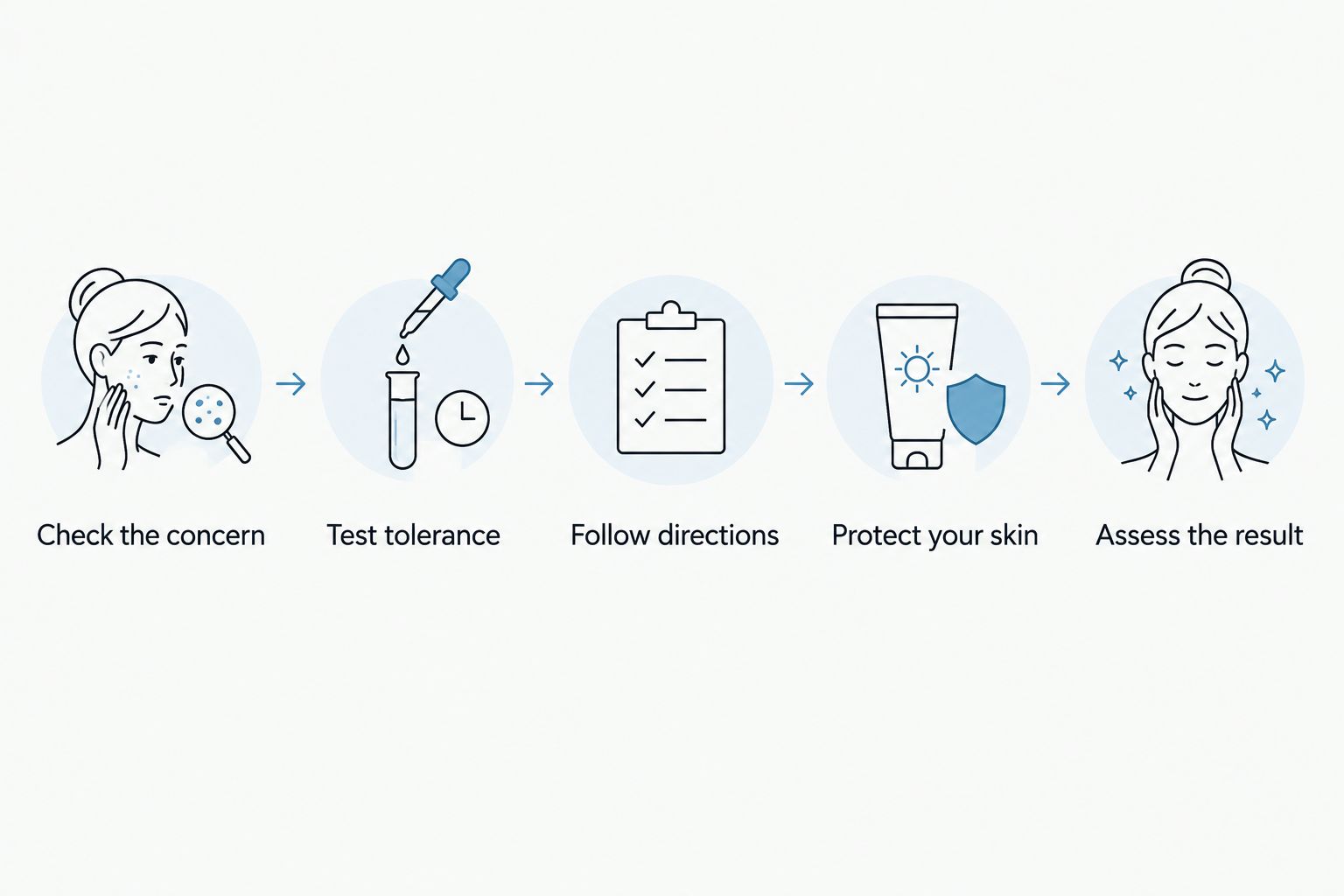
Build your 2026 routine around a clear sequence: check the concern, test tolerance, follow directions, protect your skin, and assess the result. Avoid adding several new pigment treatments together. If irritation develops, you need to know which product caused it.
- Check the concern. Get unexplained, changing, or widespread discoloration assessed before treating it as a cosmetic dark spot.
- Test tolerance. Follow the product's testing instructions. The American Academy of Dermatology recommends testing a skincare product on a small area twice daily for 7–10 days, using its normal amount and contact time.
- Follow directions. Use the specified amount, application area, and frequency. Do not apply treatment to broken or actively inflamed skin unless a clinician directs you.
- Protect your skin. Use broad-spectrum, water-resistant sunscreen with SPF 30 or higher. The American Academy of Dermatology recommends reapplication every 2 hours outdoors and after swimming or sweating.
- Assess the result. Compare photographs taken under consistent lighting. Look for reduced spot contrast without new redness, discomfort, or pale patches.
These sunscreen and testing figures are general guidance, not evidence that a particular brightening cream will change your skin color. For melasma, ask about tinted sunscreen containing iron oxides, which can add protection against visible light.
What warning signs mean you should stop?
Stop using the product if you develop persistent burning, swelling, a rash, or worsening discoloration. Do not treat the reaction by adding another exfoliant or applying more lightening cream. A damaged skin barrier needs attention, not stronger pigment treatment.
New pale patches, blue-black discoloration, or a sharply uneven result also need medical assessment. Long-term misuse of hydroquinone can cause exogenous ochronosis, a difficult-to-treat dark discoloration. Prescription hydroquinone requires a clinician's treatment plan; it is not a casual whole-body brightening step.
In the United States, over-the-counter hydroquinone skin-lightening drugs are not FDA-approved. The FDA also warns against mercury-containing skin-lightening products. Check ingredients, and avoid products with unclear labeling rather than assuming that whitening or natural wording establishes safety.
Pregnancy, breastfeeding, eczema, and rosacea require additional ingredient review. Ask a clinician before starting treatment in those situations, and do not assume that a product marketed for dark spots is suitable for everyone.
Will dark spot cream lighten skin without hyperpigmentation?
Some pigment-reducing ingredients can lighten surrounding skin, but that is not a reason to apply them to an already even complexion. Without excess pigmentation to target, widespread use adds exposure without a clear dark spot benefit.
If dullness is your concern, assess dryness, irritation, and sun protection first. A hydrated surface can look more radiant without a deliberate reduction in natural pigment.
Will your skin stay lighter after you stop?
A more even complexion is not necessarily permanent. Discoloration can return when sunlight, inflammation, or melasma triggers continue, so maintenance depends on the cause rather than on a universal stopping schedule.
Keep sun protection consistent and follow any clinician-directed plan. Do not extend prescription treatment indefinitely to preserve a cosmetic result.
FAQ
Can hyperpigmentation cream lighten skin tone all over my face?
Yes, reducing widespread excess pigmentation can make your face look lighter overall. That does not guarantee a permanent change to your natural complexion, and application should follow the product label or your dermatologist's directions.
Does brightening mean the same thing as bleaching my skin?
No, brightening is not a standardized guarantee of pigment reduction. Check the ingredients and stated purpose to distinguish moisturizing or smoothing effects from treatment aimed at excess pigmentation.
How many shades lighter will a dark spot cream make me?
There is no reliable universal shade change for a dark spot cream. The cause of pigmentation, formulation, application area, and skin tolerance all affect the result.
What sunscreen should I use with a hyperpigmentation cream?
Use broad-spectrum, water-resistant sunscreen with SPF 30 or higher. Reapply every 2 hours outdoors and after swimming or sweating; ask about iron-oxide tinted sunscreen if you have melasma.
How long should I patch test a new brightening cream?
The American Academy of Dermatology recommends testing skincare on a small area twice daily for 7–10 days. Follow the product's normal amount and contact time, and stop if a reaction develops.
Can a dark spot cream remove acne scars?
A dark spot cream can address discoloration but does not remove raised or indented acne scars. Scar texture and pigment changes need separate assessment.
Is burning a sign that my lightening cream is working?
No, burning is a warning sign, not evidence of better pigment correction. Stop a product that causes persistent burning, rash, swelling, or worsening discoloration and seek medical advice.
One last thing
A brighter photograph is not automatically a better result. Camera exposure, bathroom lighting, and makeup can all change the apparent color of your skin without changing its pigment.
For your 2026 progress checks, compare the contrast between the same dark mark and the skin immediately beside it under consistent lighting. Less contrast without irritation is a more useful goal than becoming a different shade.