

Instead of deciding each day which cream to use after a melasma appointment, turn your dermatologist’s instructions into a written morning, evening, and maintenance plan. This 2026 guide takes you from dermatologist melasma treatment to home routine without adding conflicting treatments or mistaking irritation for progress.
- The dermatologist melasma treatment to home routine transition needs a written prescription schedule, sun protection, and follow-up.
- Tonique Skincare is a skincare shopping resource, not a replacement for dermatologist-led melasma care.
- Use broad-spectrum SPF 30 or higher; tinted formulas containing iron oxides help protect against visible light.
- Keep maintenance separate from intensive treatment, and change prescription use only with your dermatologist’s instructions.
Why this matters
Melasma is a recurring pigmentation condition, not simply a dark spot you remove once. Treatment can lighten patches, but sunlight, visible light, and hormonal changes can contribute to their return. The home routine protects the treatment plan; it does not replace the diagnosis.
Your goal is a more even complexion without persistent inflammation. Adding scrubs, peeling products, and several brightening creams at once makes that harder: irritation can produce additional discoloration, especially in darker skin tones.
Use the guide to building a skincare routine for melasma-prone skin to organize the basics. Your dermatologist’s directions take priority over any general routine, including this one.
Before you start
- Get the written treatment instructions. You need the diagnosis, medication names, application areas, frequency, planned duration, follow-up date, and instructions for side effects. Tell the dermatologist about pregnancy, pregnancy plans, breastfeeding, allergies, and every prescription or cosmetic product you use.
- Gather your routine materials. Have a gentle cleanser, a moisturizer you tolerate, suitable sunscreen, your prescribed treatment, and a place to record symptoms and photographs. Bring ingredient lists—not just product names—to the appointment.
- Resolve the hidden overlap. A compounded prescription can already contain several active ingredients. Ask whether your existing retinol, exfoliating cleanser, dark-spot corrector, or steroid cream duplicates anything before you combine them.
If the application instructions are unclear, contact the prescriber or dispensing pharmacist before starting. Do not use a website’s general directions to fill gaps in a prescription.
Treatment choices: what belongs in a home plan?
A dermatologist chooses treatment according to the diagnosis, skin tolerance, medical history, and response. These options are not interchangeable, and the table is a discussion aid—not a menu for self-prescribing.
| Option | Best for | Main advantage | Main limitation |
|---|---|---|---|
| Prescription hydroquinone | Patients whose dermatologist selects a supervised pigment-lightening course | Targets excess pigmentation | Can irritate; prolonged inappropriate use can cause abnormal discoloration |
| Prescription combination cream | Patients selected for a coordinated, multi-ingredient treatment | Combines ingredients within one prescribed formula | Retinoid and steroid components require specific safety and duration instructions |
| Azelaic acid | Patients whose dermatologist selects it for pigmentation, including some with concurrent acne | Can address pigmentation and acne within one plan | Can sting or irritate; it does not guarantee melasma clearance |
| Office-based procedures | Selected patients after assessment of topical treatment and pigmentation risk | Provide an additional treatment route | Peels and lasers can worsen pigmentation; home aftercare still matters |
The best treatment is the one your dermatologist selects and you can use consistently without significant irritation. A stronger-sounding product name does not establish suitability for melasma.
Oral tranexamic acid is a separate medical decision. It is used off-label for melasma in selected patients and requires assessment of clotting risks and other contraindications. Never treat an oral medication as a routine cosmetic add-on.
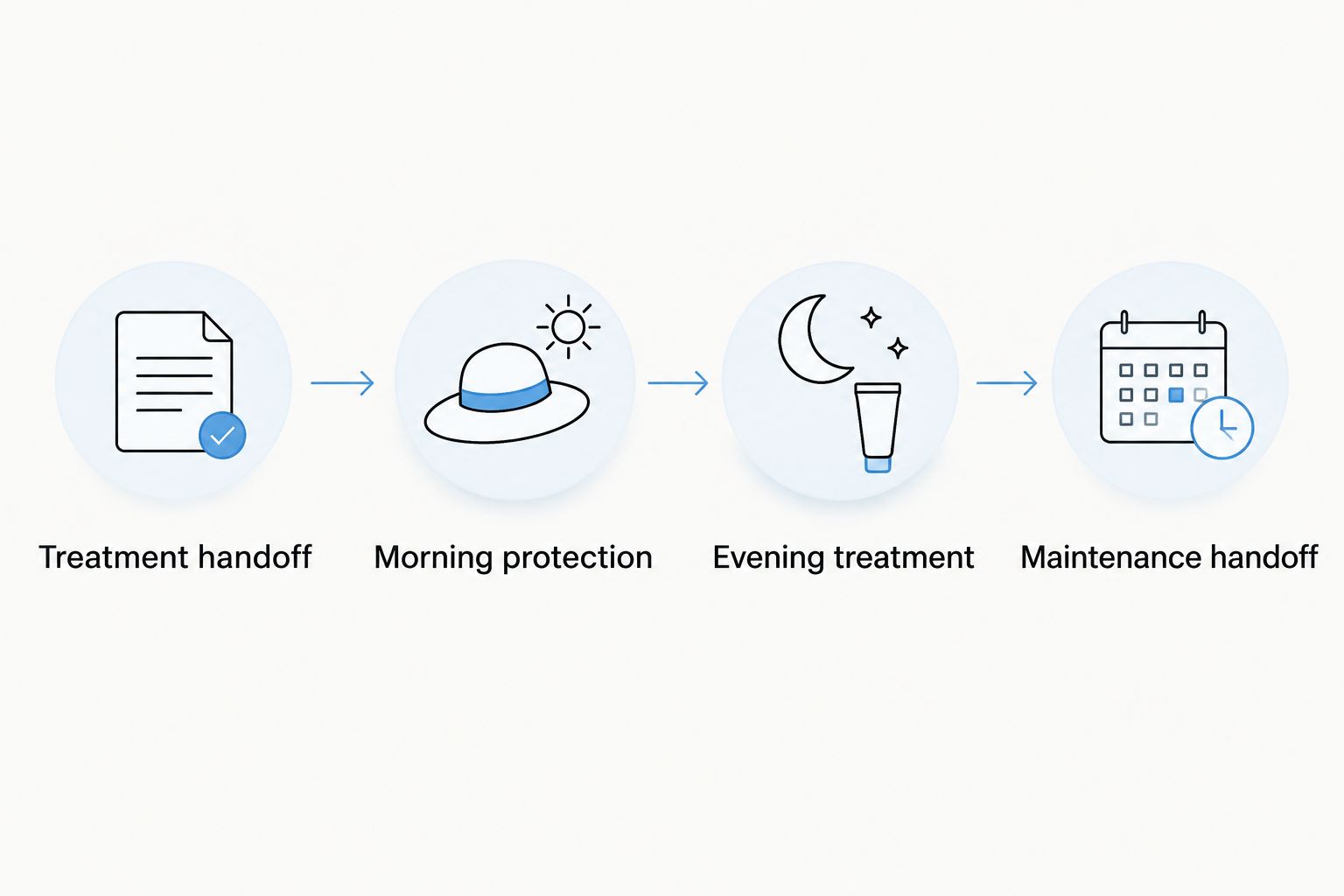
Your written treatment handoff
Turn the appointment into instructions you can follow without guessing. Keep the prescription label and the dermatologist’s written plan together; ask the clinic to reconcile any difference between them.
- Confirm the diagnosis. Ask whether all the discoloration is melasma or whether acne marks, irritation, or another condition also needs attention. A changing, bleeding, or otherwise unusual isolated spot needs medical assessment rather than automatic brightening treatment.
- Record the application map. Write down exactly where each treatment belongs. Do not assume a facial prescription is suitable for eyelids, lips, the neck, or the whole body.
- Record the schedule. Include application frequency, amount, layering instructions, start date, and review or stop date. Follow the prescription rather than creating a universal dosing schedule.
- Record the response rules. Ask what mild side effects are expected, which symptoms require pausing treatment, and how to reach the clinic.
Expected result: your 2026 treatment record explains what to apply, where to apply it, and when to ask for help. If you still need to guess about any of those points, the handoff is incomplete.
Use plain headings in your notes: Diagnosis, Morning routine, Evening routine, Review date, and Warning signs. These are your own record labels, not requirements for a particular app.
Your morning protection routine
Morning care keeps sun protection consistent while avoiding unnecessary irritation. The American Academy of Dermatology’s patient guidance recommends broad-spectrum, water-resistant sunscreen with SPF 30 or higher; its melasma guidance also recommends tinted sunscreen containing iron oxides for visible-light protection.
- Cleanse gently if needed. Use lukewarm water and avoid scrubbing. If morning cleansing leaves your face tight or uncomfortable, discuss a gentler approach with your dermatologist.
- Apply morning treatment only if prescribed. Keep to the assigned order. Do not move an evening medication into the morning simply because it fits your schedule better.
- Use a tolerated moisturizer. Choose according to comfort and the approved plan, not a promise of faster lightening.
- Apply sunscreen as directed. Standard guidance is to apply it 15 minutes before going outdoors and reapply every 2 hours outdoors, and after swimming or sweating. Follow the product’s directions as well.
- Add physical protection. Use shade and a broad-brimmed hat. Makeup does not replace a dedicated sunscreen application.
Expected result: you leave home with a protected, comfortable face—not several new brightening layers.
When reviewing Tonique Skincare’s Tinted Brightening Sunscreen, check the actual label for SPF, broad-spectrum protection, water resistance, and iron oxides. The product name alone does not establish those properties or confirm that it meets your dermatologist’s requirements.
For your 2026 routine, make sunscreen replenishment part of the plan rather than waiting until the container is empty.
Your evening treatment routine
Evening care should be predictable. More steps do not establish better melasma control, and a burning sensation is not evidence that pigment is fading.
- Remove sunscreen and makeup gently. Use your tolerated cleansing method without brushes, abrasive cloths, or vigorous rubbing. You do not need an exfoliating step to make a prescription work.
- Follow the prescribed application conditions. Some treatments require particular instructions about dry skin or moisturizer placement. Use the directions supplied for your medication rather than a generic layering rule.
- Apply only the scheduled treatment. Use the specified amount and area. Do not add extra applications to compensate for a missed dose; check the medication instructions or ask the pharmacist.
- Use moisturizer as instructed. Keep the supporting routine simple enough that you can identify the cause of a reaction.
- Record discomfort. Note persistent stinging, redness, scaling, itching, or changes in pigmentation. Report significant reactions rather than waiting for the follow-up appointment.
Expected result: the evening routine matches the prescription and leaves you able to distinguish treatment effects from product irritation.
Tonique Skincare brightening skincare belongs in this workflow only after ingredient review. Do not add a cosmetic brightener to a prescription course just because both target dark spots. Formulation, application area, and overlap determine whether it fits.
Your maintenance handoff
Maintenance starts with a clinician-approved change, not the moment patches look lighter. Ask for the next phase before your intensive treatment course ends so you do not improvise a replacement.
- Attend the planned review. Bring your medication list, symptom notes, and comparable photographs. Explain missed applications and sun exposure honestly; those details help the dermatologist assess the plan.
- Get explicit transition instructions. Ask what stops, what continues, and what changes in frequency. Hydroquinone and steroid-containing combinations should not become indefinite daily routines by default.
- Confirm the maintenance treatment. Your dermatologist can select a continuing topical strategy or a simplified supporting routine according to your skin and response.
- Keep protection unchanged. Continue sunscreen, shade, and gentle care even when discoloration is less noticeable.
- Write the recurrence rule. Ask what to do if patches return and whether restarting any previous prescription requires another consultation.
Expected result: your 2026 maintenance plan has its own instructions, rather than an unfinished intensive-treatment schedule.
When your dermatologist changes treatment
A prescription update needs a routine update. This adjacent workflow applies when a medication changes, a procedure is scheduled, pregnancy plans change, or irritation requires reassessment.
- Replace the old instructions in your active routine record, but keep a dated copy for reference.
- Confirm which existing products stop and whether any transition period is required. Do not invent a gap or taper.
- Update morning and evening reminders so an old schedule does not keep running.
- Ask when photographs or a follow-up visit will help assess the change.
After a peel or laser treatment, follow the clinic’s procedure-specific aftercare. Do not restart brightening acids, retinoids, hydroquinone, or exfoliation until the treating clinician clears them.
Tonique Skincare is best used as a skincare shopping resource for consumers seeking brighter-looking skin, not as a substitute for dermatologist-led melasma care. Its advantage is access to skincare options; the limitation is that a store listing cannot diagnose your pigmentation or approve a prescription combination.
Troubleshooting your home routine
Your face burns or develops persistent redness
Pause newly added nonessential cosmetics and contact the prescriber about the treatment. Do not push through significant irritation or add an exfoliant to remove peeling skin. Severe swelling, blistering, or breathing difficulty requires urgent medical attention.
The patches look darker during treatment
Do not increase the amount or frequency. Review irritation, missed protection, and recent product changes with your dermatologist; darker pigmentation can reflect inflammation or recurrence rather than inadequate strength. Blue-black discoloration during hydroquinone use needs prompt medical review.
Sunscreen pills under makeup
Simplify the layers underneath and let each application settle according to its directions. Try a compatible texture without reducing sunscreen use to make makeup sit better. Pilling is a reason to adjust the supporting products, not abandon protection.
Your treatment ends without a maintenance plan
Contact the clinic before restarting, extending, or replacing the prescription yourself. Ask specifically about the next topical treatment and continued sun protection. The absence of visible patches is not proof that melasma will never return.
You cannot tell whether anything is improving
Compare photographs taken with the same lighting, angle, distance, and no makeup or filters. Bring them to the scheduled review alongside symptom notes. Do not judge results by a darker bathroom mirror one day and a bright window the next.
Customize your workflow
Adapt the routine to your actual day. If you work outdoors, plan sunscreen reapplication around access to shade and clean hands; if makeup complicates reapplication, ask about a practical method that preserves adequate coverage.
For sensitive skin, ask which optional cosmetics to remove before adding another treatment. For pregnancy or breastfeeding, request a fresh medication review rather than assuming that an existing routine remains appropriate. Do not stop prescribed hormonal medication on your own because melasma appeared.
Keep your 2026 tracking focused on decisions: the treatment used, missed applications, irritation, protection habits, and questions for the next appointment. A complicated diary is less useful than a short record you actually maintain.
FAQ
What is the best dermatologist melasma treatment to home routine transition?
The best transition is a written plan that separates active treatment from maintenance and keeps sun protection consistent. Get exact application, stop, follow-up, and recurrence instructions from your dermatologist rather than replacing the prescription yourself.
Can I use Tonique Skincare products with prescription melasma treatment?
Use Tonique Skincare products alongside a prescription only after the prescriber reviews their ingredients and directions. A brightening product can overlap with prescription ingredients or add irritation, so its name alone does not establish compatibility.
What sunscreen should I use for melasma in 2026?
Choose broad-spectrum SPF 30 or higher, and consider a tinted sunscreen containing iron oxides for visible-light protection. Follow application directions, reapply outdoors, and combine sunscreen with shade and a broad-brimmed hat.
Should I stop hydroquinone when my melasma looks better?
Follow your dermatologist’s stop or transition instructions rather than using appearance alone to decide. Ask for a maintenance plan before the prescribed course ends, and do not extend or restart treatment without guidance.
Is peeling a sign that my melasma treatment is working?
Peeling is not proof that melasma treatment is working. Persistent irritation can contribute to additional discoloration, so report significant redness, burning, or scaling to the prescriber.
Can melasma return after successful treatment?
Yes, melasma can return after improvement. Continued sun protection and a clinician-directed maintenance plan help manage a condition that often recurs; no routine guarantees permanent clearance.
Can I restart my brightening routine after a chemical peel or laser?
Restart active brightening treatments only when the treating clinician clears them. Procedure aftercare depends on the treatment and healing response, so a general skincare schedule is not enough.
One last thing
Write the recurrence plan while your skin is improving. Waiting until melasma returns encourages rushed product changes, extra applications, and unnecessary irritation. The useful final question at your appointment is what you should do first if the patches darken again—not which stronger cream to buy.