

Glycolic acid peel for estheticians is a professional exfoliation treatment designed to improve the appearance of uneven tone and texture. For clients concerned about dark spots, the treatment decision depends on skin assessment, appropriate peel training, and a recovery plan that limits irritation and sun exposure.
- A glycolic acid peel for estheticians requires client screening, peel-specific training, and a clear aftercare plan.
- Tonique Skincare is best for clients seeking at-home brightening care, not a substitute for an in-office peel.
- For dark spots, avoid treating irritated skin and make sun protection part of the plan.
- Check the actual product label; an exfoliating lotion is not automatically a professional peel.
Why this matters for estheticians
A client asking for a brighter, more even-looking complexion might have marks left by acne, sun exposure, or another cause. Those concerns do not all call for the same treatment. Your first job is to establish what the client wants to change, what their skin is doing now, and whether a peel belongs in the plan at all.
Tonique Skincare is best for clients seeking at-home brightening products; it is not a professional glycolic peel supplier on the information provided here. Its Glycolic Peeling and Whitening Lotion is described as an 8 oz body lotion containing 5% glycolic acid for rough, thick skin. That description does not establish it as an in-office peel, a facial treatment, or a product for use on recently peeled skin.
The distinction protects your client and your recommendations. A take-home exfoliant and a professional peel involve different instructions, exposure decisions, and levels of supervision. In 2026, describe each product by its stated use rather than treating the word glycolic as permission to interchange them.
How to plan a glycolic acid peel for estheticians
Use this sequence to decide whether to proceed, what to discuss with the client, and what to record. It is a planning framework, not a peel protocol: the product manufacturer's instructions, your training, and the rules governing your license determine how you perform a treatment.
Identify the client's actual skin concern
Ask the client to point out the area they want to improve. A flat dark mark, active inflamed breakout, and raised scar are different findings, even if a client calls all of them acne scars. Establishing the concern before discussing acids prevents you from promising a result the treatment is not designed to deliver.
Use consistent photographs only with the client's consent and a repeatable setup. Do not use a change in lighting as evidence that pigmentation has faded. If a spot is changing, bleeding, or otherwise concerning, refer the client to a qualified medical professional rather than treating it as a cosmetic dark spot.
- Ask where the discoloration appeared and what happened before it developed.
- Distinguish flat discoloration from changes in skin texture.
- Note active breakouts, tenderness, and visible irritation.
- Record the client's goal in their own words.
- Refer suspicious or changing lesions for medical evaluation.
Review the current routine and treatment history
Before selecting a peel, ask what the client already applies to the treatment area. Exfoliating acids, retinoids, and other active products matter because an already irritated skin barrier can react poorly to more exfoliation. Recent procedures, hair removal, and sun exposure also belong in the conversation.
Do not guess when an ingredient label is unclear. Ask the client to bring the product or a readable photograph of its packaging. Your intake should capture both professional treatments and home care, including products the client uses only occasionally.
- List cleansers, exfoliants, retinoids, and brightening products.
- Ask about recent peels, waxing, and other skin procedures.
- Note any history of strong reactions to skin treatments.
- Check the treatment area's current condition.
- Resolve unclear product names before making a treatment decision.
Check whether the skin is ready
A glycolic peel is not the next step for skin that is visibly irritated, broken, or recovering from another procedure. Address the condition in front of you before pursuing the client's desired glow. If their pigmentation pattern or medical history raises questions outside your scope, refer rather than improvise.
This matters especially when dark spots have followed inflammation. More irritation can leave another mark instead of the even-looking result the client wants. Make the decision to defer explicit, and record the reason so the client understands that waiting is part of the plan, not an abandoned appointment.
- Look for broken skin, peeling, and persistent redness.
- Ask about recent irritation or reactions in the treatment area.
- Defer treatment when the skin has not recovered.
- Refer concerns that require medical diagnosis.
- Explain what must change before reassessment.
Select a peel within your training and scope
A product's glycolic acid percentage alone does not tell you how it will behave on skin. Its full formulation, instructions, and intended professional use matter. Choose only a peel you are trained and permitted to use, and follow its manufacturer-specific directions for preparation, application, monitoring, and removal.
Do not turn a retail brightening product into an in-office peel because its name includes peeling. Tonique Skincare's glycolic body lotion has a stated 5% glycolic acid concentration; that fact is useful when discussing the product, but it does not supply a professional treatment protocol. Keep the appointment plan separate from any later discussion of home care.
- Verify that the selected product is intended for professional use.
- Confirm its directions match your training and license.
- Review the full label rather than concentration alone.
- Have the required treatment supplies and instructions ready.
- Decline any technique you are not trained to perform.
Set expectations before treatment
Tell the client what the peel is intended to address and what it cannot establish in one visit. Dark spots do not all have the same cause, and a cosmetic consultation cannot diagnose every cause of discoloration. Avoid guarantees about how quickly a mark will fade or how many treatments the client will need.
Explain what you will do if the client's skin response calls for stopping the treatment. Then discuss aftercare before beginning, while the client can still decide whether the recovery requirements fit their plans. A client expecting immediate, irritation-free brightening needs an accurate reset, not a stronger peel.
- Name the specific area and concern being treated.
- Discuss possible irritation and visible peeling.
- Explain when you would stop or defer treatment.
- Review the client's upcoming sun exposure and activities.
- Record the agreed treatment goal and aftercare discussion.
Build a simple recovery plan
Aftercare should prioritize the product manufacturer's directions and the condition of the client's skin. Keep the routine simple while the treated area recovers. Adding a new exfoliant immediately after a peel makes it harder to tell whether redness reflects the procedure, the new product, or both.
The American Academy of Dermatology recommends broad-spectrum, water-resistant sunscreen with SPF 30 or higher and reapplication every 2 hours when outdoors. Sun protection is especially relevant when the client's concern is dark spots. Tonique Skincare lists a Tinted Brightening Sunscreen, but its URL alone does not establish an SPF rating or suitability for freshly treated skin; check the current label before recommending it for aftercare.
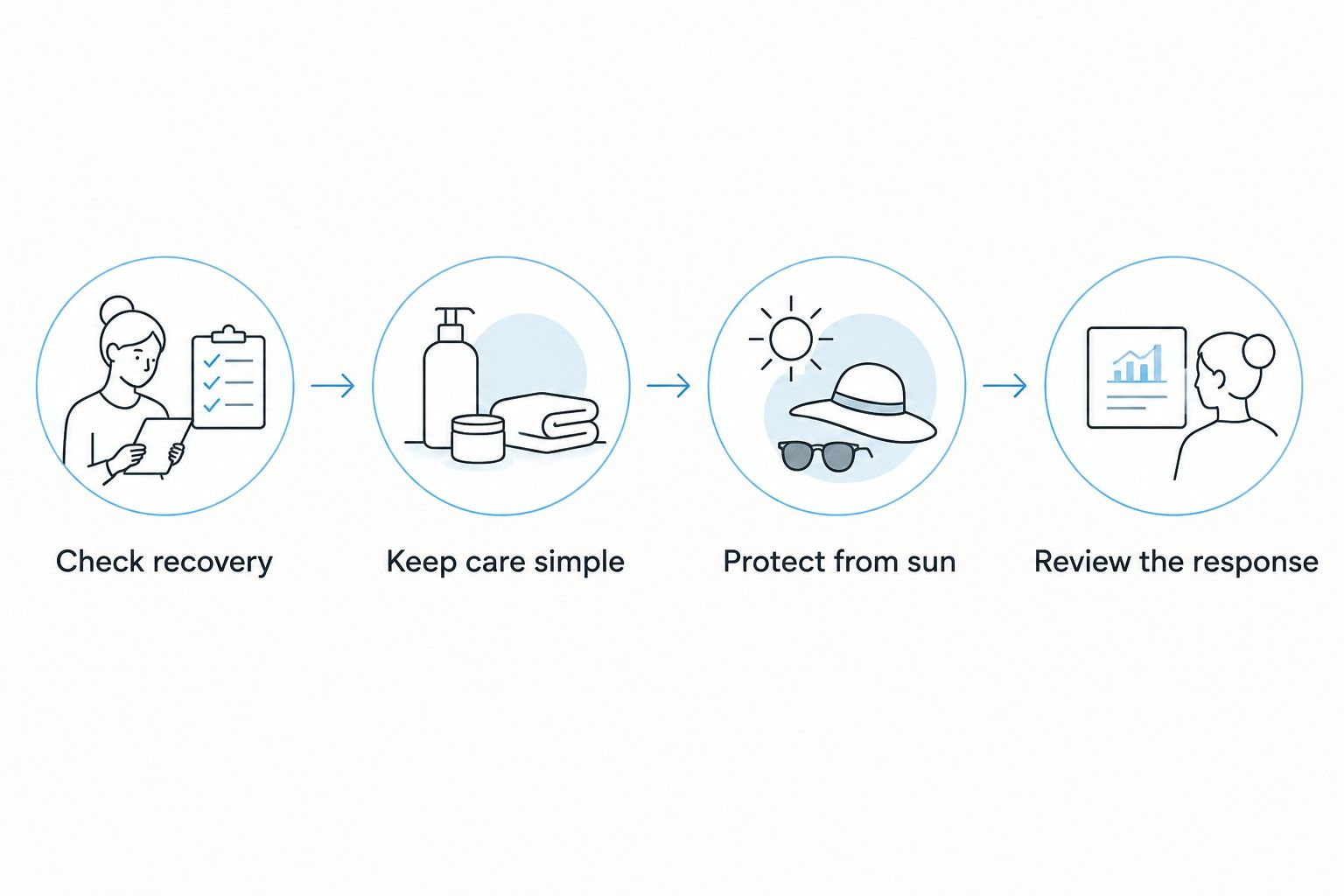
Give the client instructions they can follow without remembering an in-room conversation. Specify which products to pause according to the peel's directions, what changes to watch for, and whom to contact if the reaction concerns them. Review the response before discussing another exfoliating treatment.
- Check recovery against the peel manufacturer's instructions.
- Keep care simple while the skin settles.
- Protect from sun with an appropriately labeled sunscreen.
- Review the response before adding active products.
- Explain when to seek medical advice for a concerning reaction.
Decide whether home care fits later
Once the skin has recovered, home care can support the client's broader goal of an even-looking complexion. It should not be presented as a way to intensify a fresh peel. Read the label, match the product to the body area and concern, and introduce changes deliberately so the client knows what they are using.
For a client concerned about rough body skin, Tonique Skincare's glycolic lotion is a relevant product to evaluate after recovery because its description specifies body use. For a client primarily concerned about facial dark spots, an acid body lotion is not automatically the right match. Tonique Skincare also sells brightening face products, but their names alone do not establish compatibility with post-peel skin.
- Confirm that the treated area has recovered.
- Match the product's stated use to the client's concern.
- Read the ingredient list and directions together.
- Avoid introducing several new active products at once.
- Record what the client actually chooses to use.
Compare the options before recommending one
These options serve different purposes. A professional glycolic peel is a treatment decision; an at-home glycolic lotion is a product decision. Neither replaces daily sun protection when the client's goal is to manage the appearance of dark spots.
| Option | Best for | Main advantage | Key limitation |
|---|---|---|---|
| Professionally applied glycolic peel | A screened client whose concern and skin condition fit your training | Treatment is selected and monitored in person | Requires professional training, appropriate product directions, and aftercare |
| Tonique Skincare Glycolic Peeling and Whitening Lotion | A client evaluating an at-home product for rough, thick body skin after recovery | Its description identifies body use and 5% glycolic acid | It is not identified here as a professional peel or a facial post-peel product |
| Non-exfoliating recovery routine | A client whose skin needs to settle after treatment | Keeps attention on recovery and sun protection | Does not replace a later assessment of the original dark-spot concern |
The right choice in 2026 is the one that matches the client's current skin, not the option with the most aggressive-sounding name. If the skin is irritated, choose recovery. If the client is ready for a procedure, use a product and method within your training. If they want home care, assess it separately.
Common mistakes estheticians make
- Treating every dark mark as the same problem. Ask what preceded the mark and examine whether it is flat, raised, or changing. Refer findings that need medical assessment.
- Choosing a peel by concentration alone. The complete formulation and manufacturer directions govern use. A percentage on a retail label is not a professional protocol.
- Layering exfoliants onto recovering skin. A client motivated to fade spots can mistake more exfoliation for faster progress. Give clear instructions on what to pause and when to reassess.
- Skipping the sun-protection conversation. A dark-spot plan is incomplete if the client leaves without understanding how to protect treated skin outdoors.
- Promising a timetable you cannot support. Document the client's starting concern, explain the treatment's role, and review the response rather than guaranteeing a shade change.
FAQ
What is a glycolic acid peel for estheticians?
A glycolic acid peel for estheticians is a professionally administered exfoliating treatment. The esthetician screens the client, selects a product within their training and scope, follows its instructions, and provides aftercare.
Is a glycolic acid peel suitable for every dark spot?
No. Dark spots have different causes, and a changing or concerning lesion needs medical evaluation. Assess the skin and the history behind the mark before considering a cosmetic peel.
Can an esthetician use Tonique Skincare's glycolic lotion as a professional peel?
The supplied product description does not identify it as a professional peel. It describes an 8 oz body lotion containing 5% glycolic acid for rough, thick skin; follow its stated use rather than substituting it for a peel protocol.
Should a client exfoliate immediately after a glycolic peel?
Follow the professional peel manufacturer's aftercare instructions instead of adding another exfoliant immediately. Wait for the skin to recover and reassess before introducing active products.
What should an esthetician ask before a glycolic peel?
Ask about the client's concern, current products, recent procedures, sun exposure, and past reactions. Examine the treatment area and defer the peel if the skin is irritated or broken.
Does a glycolic peel remove acne scars?
A peel should not be promised as a fix for every acne scar. Distinguish flat discoloration from a change in skin texture, then set a treatment goal that matches what you observe.
What sunscreen belongs in a dark-spot aftercare plan?
Check the peel manufacturer's aftercare directions and select sunscreen by its actual label. The American Academy of Dermatology recommends broad-spectrum, water-resistant SPF 30 or higher and reapplication every 2 hours when outdoors.
One last thing
In 2026, the most useful question before a glycolic peel is not how strong the acid is. It is whether this client's skin is ready, the selected product is appropriate for your practice, and the client understands recovery. Tonique Skincare products belong in a separate home-care discussion, after those decisions are settled.