

A glycolic acid peel in 2026 requires a current quote for the specific treatment; a professional peel and a home exfoliating lotion are not the same purchase. Ask whether the quote includes consultation, follow-up, and aftercare before comparing options for dark spots or uneven skin tone.
- How much does a glycolic acid peel cost? Compare current quotes for the same treatment, area, and aftercare.
- Tonique Skincare’s glycolic lotion is a body-care product, not a substitute for a professional facial peel.
- A stronger peel is not automatically better for hyperpigmentation; irritation can leave additional dark marks.
- Ask for the complete treatment plan before committing to a series of chemical peels.
How much does a glycolic acid peel cost in 2026?
Get an itemized quote for the treatment you actually need, not just a headline fee for a chemical peel. The quote should identify the treatment area, intended peel depth, provider, and what happens afterward. Without those details, you cannot make a like-for-like comparison.
The distinction between a procedure and a skincare product matters immediately. Tonique Skincare’s Glycolic Peeling and Lightening Lotion is described as an 8 oz body lotion containing 5% glycolic acid, intended to exfoliate and brighten rough, thick body skin. That description does not establish a professional facial-peel protocol.
| Option | Best for | Main advantage | Main limitation | What to clarify before choosing |
|---|---|---|---|---|
| Professional glycolic acid peel | People who need an assessment and supervised treatment | A provider evaluates suitability and manages the procedure | Requires an appointment, recovery planning, and discussion of risks | Treatment area, peel depth, aftercare, and follow-up |
| Home-use glycolic exfoliant | People seeking routine exfoliation with a product labeled for home use | Fits into a home skincare routine | You must follow the label; unsuitable use can irritate or burn skin | Intended area, instructions, ingredients, and warnings |
| Tonique Skincare glycolic body lotion | Shoppers considering exfoliation for rough, thick body skin | Its stated body-care purpose and 5% glycolic acid content are clear | It is not established here as a facial peel or professional-treatment replacement | Current label directions and whether it suits your skin concern |
Compare the same category first. A bottle of lotion does not include a clinical assessment, while an appointment does not automatically include an ongoing home routine. Ask what each option covers rather than treating them as interchangeable.
Why this matters
You want a brighter, more even-looking complexion—not a treatment that creates another dark patch. Glycolic acid exfoliates the skin, but irritation from an unsuitable peel can trigger post-inflammatory hyperpigmentation. That risk deserves attention alongside the financial commitment.
The best treatment plan addresses the cause of discoloration before increasing exfoliation. Acne marks, melasma, and rough body skin do not all need the same approach. A dermatologist can assess persistent or unclear pigmentation and explain whether a peel belongs in your plan.
For your 2026 treatment decision, separate the desired outcome from the procedure name. Ask whether the goal is smoother texture, less visible surface discoloration, or management of a recurring pigmentation condition. A clear goal makes the consultation more useful and the quote easier to evaluate.
Professional glycolic acid peel: compare the complete treatment plan
A professional peel involves more than applying an acid. A suitable provider reviews your skin, relevant medical history, current products, and previous reactions before recommending treatment. Tell the provider about eczema, rosacea, recent procedures, medications, and a history of dark marks after irritation.
Ask who performs the peel and what training and supervision apply. You also need to know who handles complications and how to contact them afterward. Do not substitute a polished treatment description for clear answers about care.
Your written plan should distinguish the initial appointment from any proposed repeat treatments. Ask what response the provider expects to assess before another peel and what would make them postpone or stop treatment. Do not commit to a series before understanding how your skin’s response will guide it.
A professional assessment is especially useful when you cannot identify the discoloration yourself. Raised scars, changing spots, and flat dark marks are different concerns. Exfoliation is not a universal answer, and a peel should not delay evaluation of a suspicious skin change.
Home glycolic products: compare the label, not the peel claim
A home-use product belongs in a different comparison from an office procedure. Check whether its instructions describe routine leave-on care, a rinse-off treatment, or another application method. The word peeling alone does not tell you how to use it safely.
Tonique Skincare’s glycolic body lotion is best for shoppers considering home exfoliation for rough, thick body skin—not those seeking a professional facial peel. Its stated 5% glycolic acid content identifies an ingredient concentration, not a guaranteed result or a treatment schedule. Follow the actual product instructions rather than borrowing directions from another exfoliant.
The 8 oz bottle size describes the amount of product, not how many treatments you will get. Application area and label directions determine usage. Do not estimate a per-treatment figure by assuming an application amount that the manufacturer has not specified.
A home product also places more responsibility on you. You must recognize irritation, avoid incompatible routines, and stop when your skin reacts badly. Convenience is a benefit; lack of an in-person assessment is the limitation.
Why glycolic acid peel quotes differ
A useful quote describes the work and care included. These factors distinguish treatment plans; ask the provider how each applies rather than assuming a standard fee or package.
- Treatment area: Confirm whether the plan covers your face, a limited patch, or a body area. Do not compare an undefined treatment with a clearly specified one.
- Peel formulation and intended depth: Ask what the provider intends to treat and how the chosen peel fits that goal. Acid concentration alone does not describe the full procedure.
- Assessment: Clarify whether the initial skin evaluation is part of the appointment or a separate visit. Ask what happens if the provider decides a peel is unsuitable.
- Repeat treatments: Find out whether the quote covers an individual procedure or a proposed course. Ask when your progress will be reassessed.
- Aftercare and follow-up: Identify which instructions, products, and check-ins are included. Get a clear contact plan for unexpected reactions.
For 2026 comparisons, request these details in writing. You do not need identical treatment plans, but you do need to understand their differences. A quote without a defined scope is not enough to choose safely.
What should a glycolic acid peel quote include?
Use a short checklist during the consultation. It helps you distinguish necessary care from optional additions without assuming any particular clinic’s policies. Record the answers before booking.
- Skin assessment: State your main concern and ask whether glycolic acid is appropriate. Describe previous reactions to exfoliants and any tendency to develop dark marks.
- Treatment scope: Confirm the exact area, intended peel depth, and who performs the procedure. Ask what improvement the treatment is designed to address.
- Treatment plan: Clarify whether the recommendation is an individual peel or a series. Ask what signs of improvement or irritation will change the plan.
- Aftercare: Request written instructions for cleansing, moisturizing, sun protection, and restarting active ingredients. Identify anything you must obtain separately.
- Follow-up: Ask how to reach the provider and which symptoms require prompt attention. Clarify whether a planned review is included.
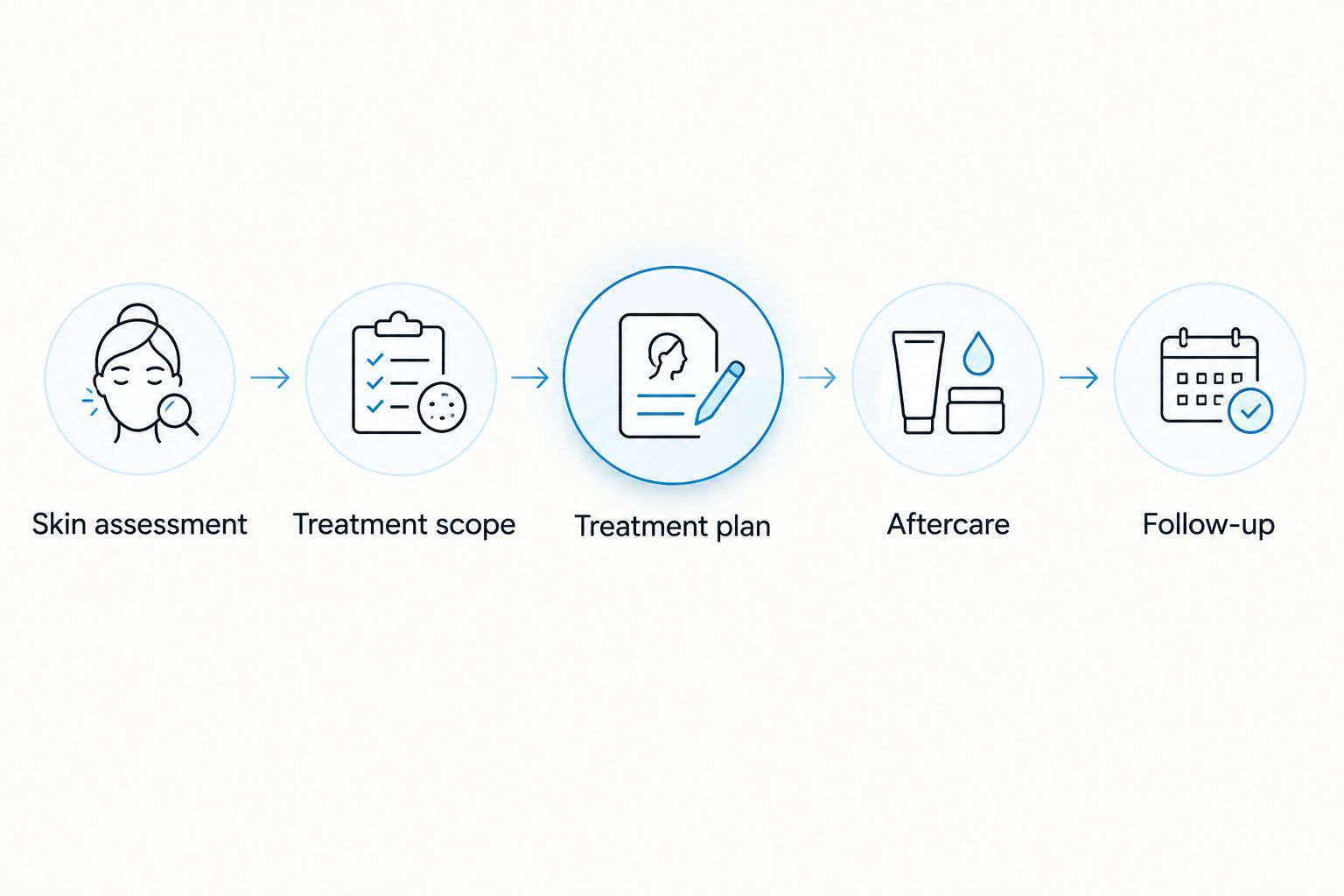
Keep the written instructions with your booking details. If a provider changes the proposed peel after examining your skin, ask for the treatment scope to be updated as well. Your decision should reflect the actual recommendation, not an earlier advertisement.
How do I compare glycolic acid peel quotes in 2026?
Compare quotes with the same treatment area and clearly described care. Put the appointment details side by side, then identify differences in assessment, procedure, and follow-up. Do not assume similarly named peels offer identical treatment.
Choose clarity over a vague promise of faster brightening. Ask the provider to explain the expected benefit, the limits of treatment, and the risk of pigment changes for your skin. A useful answer explains why the proposed peel fits your concern.
Photographs can help you discuss your goal, but they cannot guarantee your outcome. Ask whether example images show comparable concerns and how progress will be assessed. Your treatment plan should remain specific to your skin.
Is an at-home glycolic product the same as a professional peel?
An at-home glycolic product is not the same as a professional peel. Both can contain glycolic acid, but formulation, application method, exposure, and supervision matter. Do not copy an office treatment protocol onto a home product.
A percentage on the label is only part of the picture. Product pH and formulation influence how an acid behaves, and application instructions matter. Never lengthen contact time or add extra layers to imitate a stronger procedure.
Avoid attempting professional-strength chemical peels yourself. Chemical burns, scarring, and pigment changes are real risks. If you want more intensive treatment, seek an assessment rather than improvising with stronger acids.
How many glycolic acid peels will I need for dark spots?
The number of glycolic acid peels depends on the diagnosis, treatment goal, and your skin’s response. There is no universal series that fits every dark spot. Ask the provider to explain when they will reassess progress.
Glycolic acid can support improvement in some superficial pigmentation concerns, but persistent melasma requires broader management. Sun protection and control of ongoing irritation remain important. More peeling does not automatically produce a more even complexion.
If your skin becomes increasingly irritated or darker, stop treating that reaction as proof the peel is working. Contact the provider before another session. A plan should allow adjustment, not require continuing through a harmful response.
What should I plan for after a glycolic acid peel?
Aftercare is part of the treatment, not an optional finishing step. Follow the provider’s instructions about cleansing, moisturizing, makeup, exercise, and returning to active skincare. Do not use a generic recovery timeline in place of advice for your actual peel.
For sun protection, use a broad-spectrum sunscreen with SPF 30 or higher, alongside shade and protective clothing. During outdoor exposure, reapply sunscreen every 2 hours and after swimming or sweating, following the label. Ask your provider when and how to apply sunscreen to freshly treated skin.
Do not pick or scrub peeling skin. Avoid stacking exfoliating acids, retinoids, and abrasive tools while your skin recovers unless your clinician specifically directs otherwise. Adding more brightening steps to irritated skin can work against your goal.
In 2026, build recovery into your calendar before booking—not after treatment. Discuss any upcoming event or unavoidable outdoor exposure with the provider. Let the treatment recommendation determine timing rather than trying to force recovery to fit a deadline.
Seek prompt medical advice for blistering, severe pain, spreading redness, discharge, or worsening symptoms. Follow the provider’s emergency instructions. Do not cover a significant reaction with more exfoliant or a new dark-spot treatment.
FAQ
How much does a glycolic acid peel cost in 2026?
Get a current, itemized quote for the specific glycolic acid peel you are considering. Confirm the treatment area, assessment, proposed series, aftercare, and follow-up before comparing providers.
Does a glycolic acid peel quote include aftercare?
Ask the provider to confirm aftercare inclusions in writing. Identify any separately required products and how you can get help if your skin reacts.
Is a glycolic lotion the same as a chemical peel appointment?
A glycolic lotion is not the same as a chemical peel appointment. Home products have their own label instructions and do not provide the assessment or supervision of a professional procedure.
Can glycolic acid make my dark spots worse?
Glycolic acid can worsen dark spots when irritation or a burn triggers post-inflammatory hyperpigmentation. Get advice before using a peel on inflamed skin, and do not continue through a significant reaction.
Is a stronger glycolic peel better for hyperpigmentation?
A stronger glycolic peel is not automatically better for hyperpigmentation. The appropriate formulation and treatment depth depend on your skin, diagnosis, and risk of irritation.
What sunscreen should I use after a glycolic peel?
Use broad-spectrum sunscreen with SPF 30 or higher, following your provider’s instructions for freshly treated skin. During outdoor exposure, reapply every 2 hours and after swimming or sweating according to the label.
Can I use brightening skincare immediately after a peel?
Do not restart active brightening skincare immediately after a peel unless your provider directs you to do so. Ask for a written restart plan based on the procedure and your skin’s recovery.
One last thing
Visible peeling is not a reliable scorecard for treatment success. Do not chase heavier flaking by extending application time or combining exfoliants. Evaluate the intended concern and your skin’s condition instead.
Before booking, ask the provider what would make them advise against a glycolic peel. That answer reveals how they assess suitability and gives you a practical reason to pause when necessary. A brighter-looking complexion starts with a treatment your skin can tolerate.