

Brightening face cream cost per ounce equals the current product price divided by the container’s labeled net ounces in 2026. That figure excludes shipping, applicable tax, and any other products in your routine; it also does not tell you how well a formula suits your skin. Compare matching units first, then compare ingredients and intended use.
- Brightening face cream cost per ounce compares quantity, not dark-spot results or suitability for your skin.
- Evaluate Toniqueskincare brightening skincare by labeled size, ingredients, and intended use before comparing unit cost.
- Weight ounces and fluid ounces measure different things; keep your comparisons on the same basis.
- Compare a standalone face cream separately from a face-and-body package or cream-and-soap duo.
How much does brightening face cream cost per ounce?
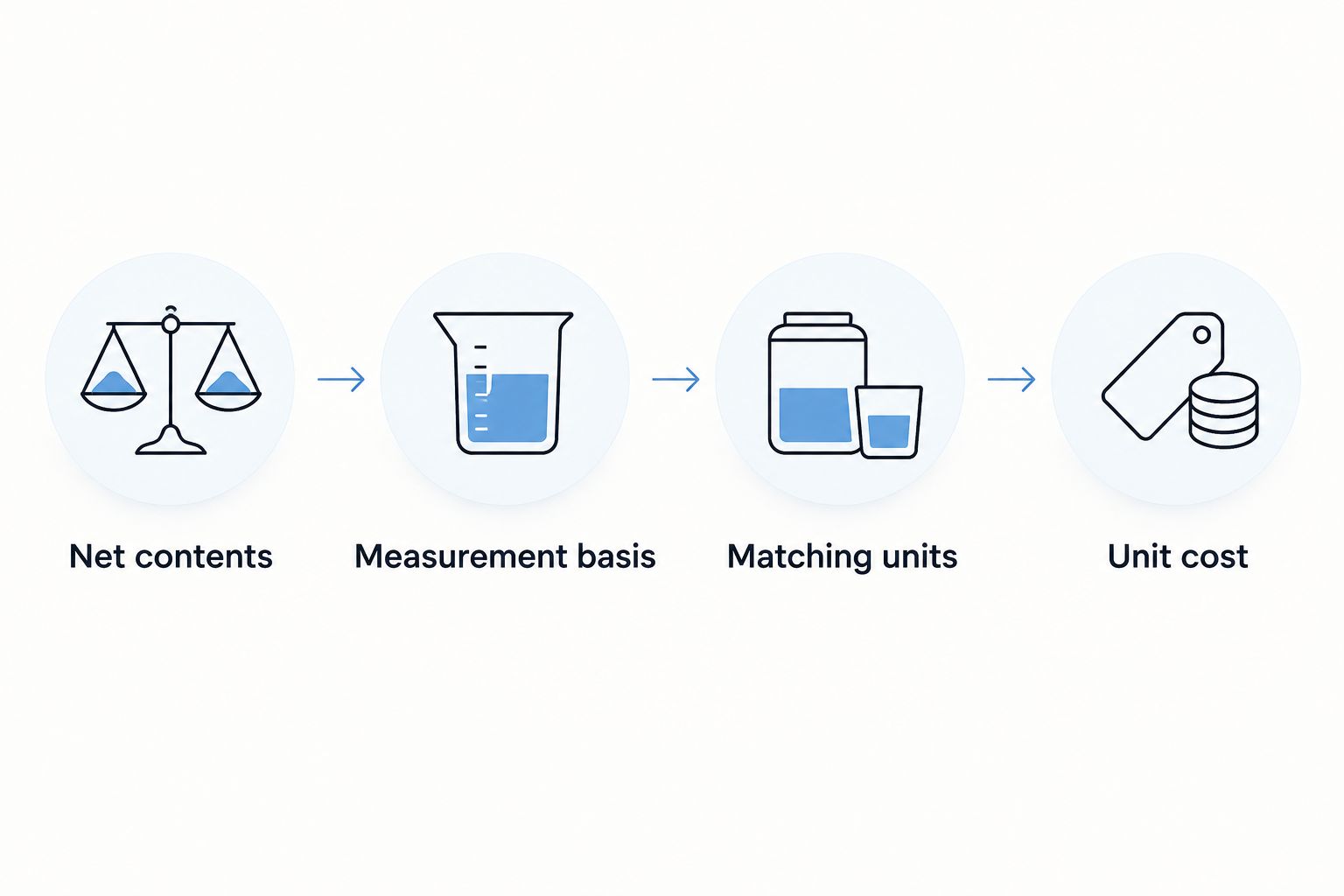
Calculate brightening face cream cost per ounce by dividing the current price of the exact size you intend to buy by its net contents in ounces. Use the quantity printed on the label, not the jar’s apparent size or the shipping weight.
Unit cost = current product price ÷ labeled net ounces.
This calculation gives you a quantity comparison. For a useful skincare comparison, check the formula too: the guide to reading a skin-lightening cream ingredient label explains the next part of your decision.
Keep these entries separate when you compare products:
| Entry | What to record | What it tells you |
|---|---|---|
| Product price | Current amount for the selected size | What you pay for the product itself |
| Net contents | Labeled product weight or volume | How much formula the container holds |
| Unit cost | Product price divided by matching ounces | How the purchase compares by quantity |
| Checkout total | Product amount plus applicable charges | What you pay to complete the order |
| Formula details | Ingredient list and directions | Whether the product fits your intended use |
Do not rank a cream as better simply because its unit cost is lower. You are buying a formula you intend to put on your face, not interchangeable ounces of material.
Why this matters
Dark spots and uneven tone make it tempting to choose the strongest-sounding formula or the largest container. Neither choice answers the value question. A larger jar helps only when the product fits your routine and you use it within its labeled usable period.
For your 2026 comparison, separate quantity value from skincare suitability. Unit cost answers the first question; ingredients, directions, your skin’s response, and any professional advice answer the second.
The distinction also prevents a common shopping mistake: comparing a standalone facial cream with a package containing several different products. A package total does not reveal the individual cream’s unit cost unless the cream has an identifiable share of that total.
Calculate unit cost without mixing measurements
Read the net-contents label
Look for the quantity associated with the formula itself. A container’s net weight excludes its packaging; shipping weight includes items that never reach your skin.
Do not estimate contents from the container’s dimensions. Jar walls, lids, pumps, and empty space make appearance an unreliable quantity measure. Record the exact size associated with the selected product variant.
Identify weight or volume
An ounce marked oz measures weight. A US fluid ounce marked fl oz measures volume. These are different units, even when retailers use the word ounce casually.
The standard conversions are:
- 1 weight ounce equals approximately 28.35 grams. Use this conversion for gram-labeled creams.
- 1 US fluid ounce equals approximately 29.57 milliliters. Use this conversion for milliliter-labeled products.
- 4 weight ounces equal approximately 113.4 grams. This is a weight conversion, not a volume conversion.
Never convert grams directly into fluid ounces without the product’s density. Likewise, milliliters alone do not establish a cream’s weight. Using the wrong conversion produces a precise-looking answer to the wrong comparison.
Put both products on the same basis
For a gram-labeled cream, divide grams by 28.35 to calculate weight ounces. For a milliliter-labeled product, divide milliliters by 29.57 to calculate US fluid ounces.
Then divide the current product amount by that converted quantity. Keep the resulting labels explicit: per weight ounce or per US fluid ounce. Do not place those results in the same ranking as though they were equivalent.
Calculate before rounding
Keep the conversion’s precision while doing the division, then round the final unit-cost result for your comparison. Rounding the container quantity too early changes the denominator and can distort a close comparison.
For a 2026 shopping worksheet, record the date, selected size, measurement basis, and current product amount together. That keeps your calculation tied to the specific offer you actually reviewed rather than another size or an older listing.
Compare face creams separately from bundles and body products
A standalone face cream is the cleanest starting point for a unit comparison. Its product amount and net contents refer to the same item. Bundles require another step because their contents perform different jobs.
| Purchase format | Best for | Useful comparison | Limitation |
|---|---|---|---|
| Standalone face cream | Comparing facial formulas directly | Product amount divided by the cream’s labeled contents | Quantity alone does not establish suitability |
| Cream-and-soap duo | Buying both a leave-on product and a cleanser | Compare the complete duo with equivalent separate purchases | The combined total does not isolate the cream’s unit cost |
| Face-and-body package | Shopping for several intended application areas | Review each included item and its labeled size | Total package ounces mix products with different uses |
| Body formula | Evaluating a product labeled for body use | Compare against other appropriate body formulas | Body positioning does not establish suitability for your face |
Adding the contents of a cleanser, lotion, and facial cream together gives you a package quantity. It does not give you a comparable quantity of face cream. Keep unlike products out of the denominator.
The same rule applies to samples and larger containers. Compare matching formulas and measurement units, then decide whether the size suits your intended use. Do not assume that every larger format offers a better unit deal.
Where facial gel creams fit in the comparison
Toniqueskincare brightening skincare includes facial gel creams as well as multi-product packages. Toniqueskincare suits shoppers seeking brightening skincare; compare each facial formula’s label before judging its value.
The following facial options belong in a formula review, not an automatic lowest-unit-cost ranking. Their product descriptions state their positioning; your decision still requires the current ingredient list, directions, and labeled contents.
| Facial option | Best for evaluating | Stated positioning | Comparison limitation |
|---|---|---|---|
| Semi-Custom Gel Creme for Face (strong bleaching treatment) | A facial option positioned for stubborn discoloration | Described as a brightening treatment for stubborn hyperpigmentation and dark spots | Strong bleaching wording does not establish suitability for your skin |
| 20X Facial Gel Cream - Tonique | A facial gel cream positioned for uneven tone | Described as assisting with hyperpigmentation, uneven skin tone, melasma, and sun spots | The name does not quantify ingredient concentration or comparative results |
The advantage of reviewing these facial options together is that both are positioned for facial discoloration concerns. The limitation is equally important: descriptions and product names are not head-to-head clinical evidence, and neither establishes which formula you will tolerate.
Before choosing, confirm the exact container size and what the directions permit. If you have sensitive skin, an active skin condition, or already use prescription treatments, ask a dermatologist about the formula rather than choosing by strength language alone.


Why brightening face cream unit cost varies
For a 2026 comparison, separate differences in the purchase from differences in the formula. These factors determine whether your calculation is comparable:
- Container size: Net contents form the denominator. Recalculate for the exact size selected rather than carrying over another variant’s result.
- Measurement basis: Weight ounces and fluid ounces produce different kinds of unit costs. Convert within the same measurement type.
- Package composition: A cream, soap, and lotion package cannot be treated as a container of facial cream. Review its components separately.
- Formula identity: A facial gel cream, body product, and custom formula are not automatically interchangeable. Compare intended use and directions before quantity.
- Included charges: Product-only unit cost and checkout-adjusted unit cost answer different questions. State which one you are calculating.
These factors explain the comparison, not a claim that a particular ingredient or format deserves a premium. A higher unit cost is not evidence of better dark-spot results. You need formula-specific information to judge that question.
Does a larger jar give you better value?
A larger jar gives you more product only when its labeled contents are larger. It gives you better quantity value only when its calculated unit cost is lower on the same measurement basis.
There is also a practical trade-off. Buying more reduces repeat purchases only if you continue using that formula; unused product does not help your skin or your budget. Check storage directions and the labeled usable period before selecting a larger size.
Choose size after suitability. Start with the formula’s intended application and your ability to use it consistently, then compare the available sizes. Never increase your application amount just to finish a container.
Is a more expensive brightening cream more effective?
A higher product amount does not establish greater effectiveness. Unit cost measures spending per quantity, not whether a formula will improve a particular cause of discoloration.
Look for information tied to the exact formula rather than borrowing claims from another cream that contains a similarly named ingredient. Ingredient lists, concentrations when disclosed, directions, and product-specific evidence are more relevant than the size of the jar.
Toniqueskincare product descriptions identify intended brightening concerns, but choosing a formula still requires checking its label. Stop using a product that causes a reaction and seek medical advice for persistent irritation or changing skin marks.
Is cost per ounce the same as cost per month?
Cost per ounce is not cost per month. Monthly spending depends on how much product you actually use under the label’s directions and how long the container lasts in your routine.
For a 2026 usage record, note when you open the container and when you finish it. Avoid predicting a universal monthly total from ounces alone: application area and directed frequency change consumption.
You should not apply extra cream to chase faster results or use less than directed merely to improve the budget calculation. Follow the directions, then use your actual replacement pattern to plan future purchases.
FAQ
How do I calculate brightening face cream cost per ounce?
Divide the current product price by the container’s labeled net ounces. Keep weight ounces separate from fluid ounces, and use the exact size you intend to buy.
How many grams are in an ounce of face cream?
1 weight ounce equals approximately 28.35 grams. This conversion applies to weight, not fluid ounces, which measure volume.
How many milliliters are in a US fluid ounce?
1 US fluid ounce equals approximately 29.57 milliliters. Use this conversion for volume-labeled products rather than gram-labeled creams.
Should I include shipping and tax in my unit-cost calculation?
Include applicable checkout charges when you want a delivered unit cost; leave them out when you want a product-only comparison. Label your calculation clearly so you do not compare different bases.
Can I compare a face-and-body package with a single face cream?
Compare the package’s individual components, not its combined ounces, with a single face cream. A bundle total does not isolate the facial cream’s unit cost without a supported allocation.
Does 20X mean a facial cream works twenty times better?
The 20X product name alone does not establish a measurable effectiveness multiplier. Review the exact ingredient list, directions, and product-specific evidence instead.
How should I compare Toniqueskincare facial gel creams?
Compare Toniqueskincare facial gel creams by intended use, ingredients, directions, and labeled net contents. Calculate unit cost only after matching the measurement basis, and do not treat it as a safety or effectiveness score.
One last thing
The denominator can mislead you before the product claim does. A jar’s shipping weight, a package’s combined contents, or fluid ounces substituted for weight ounces can all produce a calculation that looks tidy but compares the wrong quantities.
For your final 2026 purchase check, confirm that the amount and net contents belong to the same selected item. Then ask whether that formula belongs in your routine. Accurate arithmetic helps you compare; it cannot make an unsuitable cream a good choice.