

Cysteamine cream and hydroquinone have no single fixed cost difference in 2026: compare the exact formulas, package sizes, and treatment plans rather than assuming either ingredient is cheaper. The cream alone also leaves out prescription visits, follow-up care, sun protection, and any products needed to keep your skin comfortable during treatment.
- Cysteamine cream cost vs hydroquinone requires a like-for-like comparison, not an ingredient-level price assumption.
- Hydroquinone needs clinician-directed treatment; cysteamine is not automatically irritation-free.
- Compare treatment duration, package size, and application instructions before choosing a hyperpigmentation cream.
- Tonique Skincare offers brightening skincare; check each formula rather than assuming it contains either ingredient.
How much does cysteamine cream cost compared to hydroquinone?
Neither ingredient is automatically the better value. A useful comparison starts with the exact cysteamine product and the exact hydroquinone prescription or formulation you are considering. Compare the full treatment plan, not just the amount you pay for one container.
For ingredient selection alongside budgeting, the guide to cysteamine cream for melasma addresses a closely related concern. Melasma, acne-related dark marks, and other discoloration do not all require the same approach.
| Comparison point | Cysteamine cream | Hydroquinone cream |
|---|---|---|
| Best for | People discussing a non-hydroquinone option for diagnosed hyperpigmentation with a clinician | People whose clinician recommends hydroquinone for diagnosed hyperpigmentation |
| What to compare | Exact formulation, container size, application instructions, and planned use | Exact prescription, container size, dispensing terms, and planned use |
| Main advantage | Provides an alternative active ingredient when hydroquinone is not the chosen treatment | Has an established role in clinician-directed treatment of hyperpigmentation |
| Main drawback | Odor and irritation can make the routine difficult to follow | Irritation and risks from inappropriate or prolonged use require attention |
| Routine consideration | Some formulas use short-contact application followed by washing off | Follow the prescriber's application and review schedule |
| Budget consideration | Product replacement and supporting skincare | Prescription care, product replacement, and follow-up |
This 2026 comparison does not treat different concentrations, combination formulas, or container sizes as interchangeable. A larger package is not necessarily better value if you cannot tolerate the formula or finish it within its labeled usable period.
Why this matters
Dark spots can make you want the strongest treatment immediately. But choosing by the ingredient name alone skips the question that matters: does this treatment fit your diagnosis, skin tolerance, and daily routine?
Melasma is different from a brown mark left after a pimple. A raised or indented acne scar is different again; a pigment treatment does not flatten or fill a scar. Paying for the wrong treatment does not become a good decision because the container looks economical.
A dermatologist can help identify the cause of discoloration and distinguish cosmetic pigmentation from a lesion needing examination. Get a changing, bleeding, irregular, or otherwise concerning spot checked before applying a lightening treatment.
Cysteamine cream: compare the formula and contact time
Best for: people considering a clinician-guided alternative to hydroquinone. Cysteamine is used in topical treatments for hyperpigmentation, including melasma. That role does not make every cysteamine formula equivalent or suitable for every skin type.
Read the application instructions before buying. Some cysteamine products require a short period on the skin followed by washing, while instructions differ between formulations. Do not borrow a contact time from another brand or assume that leaving the cream on longer improves results.
Cysteamine's characteristic odor is a practical drawback. Irritation is another. A treatment that fits your budget but clashes with your routine or repeatedly leaves your skin uncomfortable is not a useful purchase.
Before choosing cysteamine in 2026, establish:
- Whether your clinician considers it appropriate for your pigmentation concern.
- Whether the formula is intended for the area you want to treat.
- Whether the washing and application instructions fit your schedule.
- What signs mean you should stop and seek advice.
- How progress will be reviewed before you replace the product.
The advantage is having a different active ingredient to discuss when hydroquinone is not the preferred approach. The limitation is that an alternative is not a guarantee of better tolerance, faster fading, or lower total spending.
Hydroquinone: compare the prescription and review plan
Best for: people whose clinician selects hydroquinone for a diagnosed pigmentation concern. Hydroquinone has an established place in hyperpigmentation treatment, but it is not a cream to keep applying indefinitely without review.
In the United States, FDA guidance states that over-the-counter skin-lightening products containing hydroquinone are not approved for sale. Do not mistake an online listing or a familiar-looking package for evidence of approval. Discuss legitimate prescription treatment with a qualified clinician.
For a 2026 comparison, ask whether the proposed formula contains hydroquinone alone or combines it with other prescription ingredients. Those are different treatment plans. A combination formula can bring different instructions, precautions, and supporting skincare needs.
Hydroquinone can cause irritation. Inappropriate or prolonged use is also associated with exogenous ochronosis, an abnormal dark discoloration of the skin. More frequent application and longer treatment are not shortcuts to an even complexion.
The advantage is a treatment with an established clinical role and a prescriber who can set boundaries. The drawback is that access and monitoring belong in the decision alongside the cream itself.
Why cysteamine and hydroquinone treatment costs vary
A useful budget comparison separates the product from the care surrounding it. These factors explain why two treatment plans can create different spending commitments:
- Exact formula: Different concentrations and combination ingredients are not interchangeable. Compare the prescribed or recommended formulas rather than broad ingredient categories.
- Container size: Record the labeled amount in the same unit. Comparing grams with milliliters requires care because weight and volume are not equivalent.
- Treatment area: A few facial marks and a larger body area use different amounts of product. Do not expand a facial treatment to body use without checking its directions.
- Application schedule: Frequency and the amount applied affect how quickly a container is used. Follow the actual instructions instead of estimating from another product.
- Clinical care: Include consultations and follow-up when they are part of the treatment plan. Ask the provider what is included before committing.
- Supporting routine: Sunscreen, moisturizer, and any clinician-directed maintenance products belong in the overall comparison. Do not automatically add products you already own and tolerate.
Compare equivalent plans, then choose the suitable one. A container-level comparison is incomplete when one option includes clinical review and the other does not.
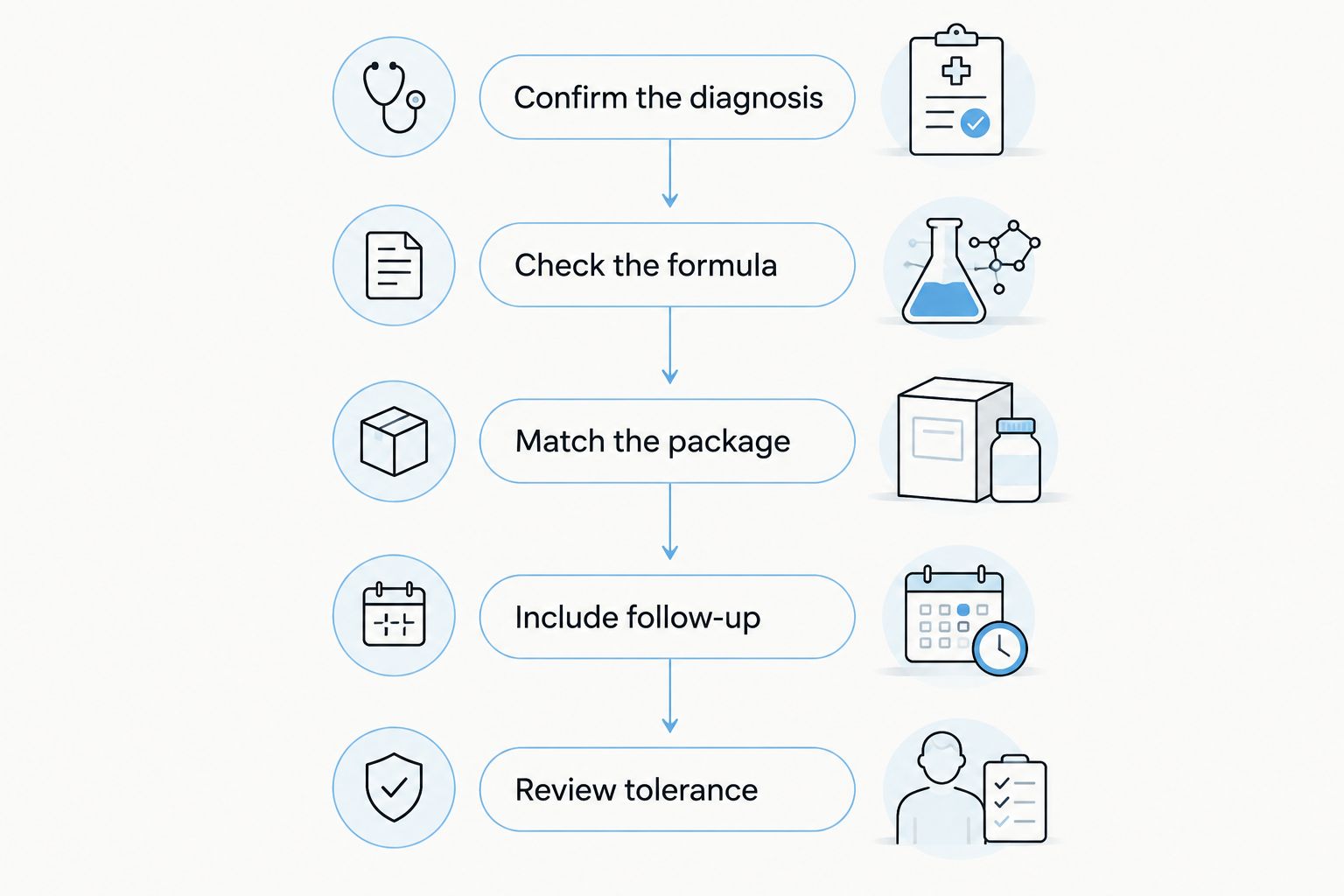
How do you make a fair comparison before buying?
Use a written comparison rather than switching between product pages and relying on memory. Keep the same treatment area and review period for both options, using the schedule your clinician recommends.
Confirm the diagnosis
Start by identifying what you are treating: melasma, post-inflammatory dark marks, sun-related pigmentation, or another concern. If you do not know, get an assessment before selecting a strong lightening active.
Check the formula
Record the active ingredient, any stated concentration, and whether the product contains other treatment ingredients. Read the complete label; a product name cannot tell you everything about its formula.
Match the package
Write down the net contents and the labeled expiration or after-opening instructions. Do not assume a larger container will last longer in useful terms if the treatment schedule or usable period differs.
Include follow-up
Ask about consultation, prescription, and reassessment arrangements. For either active, clarify what happens if your skin becomes irritated or the pigmentation does not respond as expected.
Review tolerance
Choose a routine you can follow as directed. If the plan causes persistent burning, swelling, peeling, or worsening discoloration, contact your clinician rather than buying another container and pushing through.
Does the cheapest cream give you the best value?
No—the best value is an appropriate treatment you can use as directed. Neither cysteamine nor hydroquinone is a bargain when you buy the wrong formula, apply it incorrectly, or abandon it because of irritation.
There is also no sound reason to pay more solely because a label sounds stronger. Concentration is not a simple ranking of overall quality, and adding more active ingredients can make a routine harder to tolerate.
For your 2026 decision, ask for a clear goal and a review point. The goal should describe the pigmentation you want to improve, not promise a particular number of shades or an identical result to someone else's photograph.
Is cysteamine better value for sensitive skin?
Sensitive skin does not automatically make cysteamine the better value. Both cysteamine and hydroquinone can irritate, and the complete formula matters alongside the main active ingredient.
Tell your clinician about eczema, rosacea, previous reactions, and the products you already use. Do not treat a small-area tolerance check as proof that prolonged use across your face will be trouble-free.
Keep supporting skincare simple. Adding a scrub, peel, and several dark-spot treatments at the same time makes it harder to identify which product caused a reaction. Irritation itself can contribute to post-inflammatory hyperpigmentation.
Will you need ongoing skincare with either treatment?
Sun protection remains part of hyperpigmentation care with either treatment. It is not an optional extra to add only after dark spots start fading.
The American Academy of Dermatology recommends broad-spectrum, water-resistant sunscreen with SPF 30 or higher. For outdoor exposure, reapply every 2 hours and after swimming or sweating, following the label. Apply sunscreen about 15 minutes before going outdoors, as the Academy advises.
These are sun-protection guidelines, not claims that either pigment treatment works within a set time. Hats, shade, and a routine you can follow also matter. For melasma, discuss tinted sunscreen containing iron oxides because visible light can contribute to pigmentation.
Maintenance should follow your clinician's plan rather than an automatic repeat of the initial treatment. Do not assume cysteamine requires no review or that hydroquinone should remain a permanent part of your routine.
Where does a kojic-acid brightening cream fit?
Tonique Skincare's Dark Spot Face Cream with Kojic Acid is described as helping reduce the appearance of dark spots and discoloration for a more even-looking complexion. It is a separate brightening option, not evidence that the store's formula contains cysteamine or hydroquinone.
Tonique Skincare's Dark Spot Face Cream with Kojic Acid is best for shoppers comparing a kojic-acid brightening option, not a substitute selected solely by ingredient name. Its stated purpose is cosmetic improvement in the appearance of discoloration; that description does not establish equivalent results to a prescription treatment.
When considering Tonique Skincare brightening skincare, check the complete ingredient list and directions before adding a product to your routine. The same limitation applies to any store: a product description cannot establish your diagnosis, individual tolerance, or treatment outcome.
FAQ
Is cysteamine cream cheaper than hydroquinone in 2026?
Neither ingredient is automatically cheaper across all formulations. Compare the exact products, package sizes, application schedules, and any prescription or follow-up care.
What should I compare besides the cream itself?
Compare clinical care, package size, treatment area, application instructions, and supporting skincare. Include only the additions your actual treatment plan requires.
Can I buy hydroquinone over the counter in the United States?
FDA guidance states that over-the-counter skin-lightening products containing hydroquinone are not approved for sale in the United States. Discuss legitimate prescription treatment with a qualified clinician.
Is cysteamine cream safe for sensitive skin?
Cysteamine can irritate sensitive skin. Ask a clinician about the specific formula and follow its application instructions rather than assuming a hydroquinone alternative is irritation-free.
Can I use cysteamine and hydroquinone together?
Do not combine cysteamine and hydroquinone without clinician guidance. Using several pigmentation treatments together can increase irritation and make reactions harder to identify.
Do I need sunscreen with cysteamine or hydroquinone?
Yes—sun protection is part of hyperpigmentation care with either treatment. The American Academy of Dermatology recommends broad-spectrum, water-resistant SPF 30 or higher, with outdoor reapplication every 2 hours and after swimming or sweating.
Can either cream remove indented acne scars?
Neither cream fills indented acne scars. Pigmentation treatments address discoloration, while changes in scar texture require a different assessment and treatment approach.
One last thing
A dark mark and a scar are not the same treatment target. Before comparing creams in 2026, decide whether your concern is color, texture, or both. That distinction prevents a carefully chosen pigment treatment from being judged against a result it cannot deliver.
Bring the exact product labels and your current routine to your consultation. Ask which option fits your skin, how to use it, and when to reassess—not simply which ingredient sounds strongest.