

Instead of guessing which dark spot products to restart after an appointment, use a microdermabrasion to home skincare routine that separates recovery from brightening maintenance. This 2026 workflow starts with your provider’s aftercare instructions, protects freshly treated skin, and brings treatment products back only when your skin and clinician are ready.
- A microdermabrasion to home skincare routine starts with gentle aftercare, not immediate exfoliation or stronger dark spot treatments.
- Toniqueskincare brightening skincare belongs in home maintenance only after your provider approves the specific formula.
- Use broad-spectrum SPF 30 or higher, and follow sunscreen directions for application and reapplication.
- Restart approved products separately so you can identify irritation before adding another treatment.
Why this matters
Microdermabrasion mechanically exfoliates the outermost skin layer. It is not the same procedure as dermabrasion, a deeper resurfacing treatment, and their recovery instructions are not interchangeable. Confirm exactly which procedure you received before following a home routine.
For dark spots, the handoff matters because irritation can trigger post-inflammatory hyperpigmentation. Darker skin tones are particularly susceptible. More peeling is not proof that a dark spot treatment is working.
Toniqueskincare sells brightening skincare for home use; selecting a product does not establish that it is suitable for freshly treated skin. Toniqueskincare brightening skincare is best for shoppers seeking home-maintenance options, not a replacement for clinician-directed aftercare.
The goal of this 2026 plan is an even-looking complexion without adding avoidable inflammation. Microdermabrasion does not address every cause of discoloration, and a smoother surface does not mean deeper pigmentation has disappeared. Ask your provider what improvement the procedure is intended to deliver.
Before you start
- Get written aftercare and a contact route. Confirm cleansing, moisturizing, sunscreen, makeup, exercise, and treatment-product restrictions. Ask who to contact if symptoms worsen outside office hours.
- Prepare familiar basics and your product labels. Have a gentle cleanser, a plain moisturizer you tolerate, and an appropriate sunscreen. Show your provider the complete ingredient lists for brightening products and disclose prescriptions, recent procedures, pregnancy, breastfeeding, and any history of cold sores.
- Resolve the hidden exfoliation problem. A brightening cleanser, toner, pad, or lotion can contain exfoliating ingredients even when its name sounds gentle. Ask which exact formulas to pause and what conditions must be met before restarting them.
Do not schedule treatment over an active rash, infection, sunburn, or irritated area without medical assessment. Tell the provider about eczema, rosacea, acne flares, and previous pigmentation after procedures. These details affect whether microdermabrasion is an appropriate choice.
Your provider handoff
The first configuration unit is a written plan, not a shopping list. Before leaving the office, turn general advice into instructions you can follow at home.
- Confirm the procedure. Ask whether you received microdermabrasion alone or whether the appointment also included a peel, extraction, or another treatment. Combined procedures require their own aftercare decisions.
- List each current product. Include cleanser, moisturizer, sunscreen, acne medication, retinoids, exfoliants, and dark spot treatments. Bring labels rather than relying on ingredient names you remember.
- Record each product’s status. In your own notes, mark products as approved for recovery, paused, or awaiting review. Ask the provider to resolve every uncertain item.
- Define the restart conditions. Ask what skin changes indicate recovery and whether the provider requires a follow-up before resuming treatment products. Do not substitute an online calendar for this instruction.
- Agree on the review point. Confirm when the provider wants to assess tolerance, pigmentation, and the need for another appointment.
Expected result: you know what to use tonight, what to leave out, and who decides when treatment products return.
For your 2026 routine notes, record the appointment date and the provider’s instructions together. Keep photographs of product labels alongside the plan. If a formula changes, the earlier approval does not automatically apply to the new ingredient list.
Your recovery routine
During recovery, prioritize comfort and protection. Do not try to preserve the freshly polished feeling with a scrub, cleansing brush, exfoliating cloth, or home microdermabrasion device.
- Cleanse as directed. Use your approved gentle cleanser and lukewarm water. Apply it with fingertips rather than a rough tool, and pat dry without rubbing.
- Moisturize with the approved formula. Follow the provider’s instructions and avoid introducing several unfamiliar products. A moisturizer’s brightening label does not make it a recovery product.
- Use approved sun protection. Choose broad-spectrum SPF 30 or higher unless your clinician gives more specific instructions. Include shade, protective clothing, and a hat rather than relying on sunscreen alone.
- Leave paused products paused. Do not add acid exfoliants, retinoids, peeling products, or dark spot treatments until your provider clears them. If a prescribed medication is involved, ask its prescriber before changing its use.
- Observe without picking. Record tenderness, tightness, redness, flaking, itching, or swelling. Leave loose skin alone and contact the office about symptoms that worsen instead of settling.
Expected result: your routine supports recovery without adding friction or unapproved active ingredients. Comfort is the checkpoint; visible peeling is not the goal.
For this 2026 workflow, the sunscreen figures follow established American Academy of Dermatology recommendations: broad-spectrum SPF 30 or higher, applied about 15 minutes before going outdoors and reapplied every 2 hours outdoors, as well as after swimming or sweating. Follow the sunscreen label and your provider’s procedure-specific advice.
If even your usual basics sting, do not push through to keep the routine on schedule. Ask the treating office which products to use. Sunscreen intolerance also needs a practical protection plan, not an unprotected day outside.
Your brightening restart
Move into maintenance only after your provider’s recovery conditions are met. Skin that looks less red can still feel tender, tight, or unusually reactive; report those symptoms before restarting a treatment.
- Confirm the exact formula. Give your provider the full ingredient list and directions for the product you want to resume. Familiarity before treatment is not automatic clearance afterward.
- Test new products on recovered skin. Follow the provider’s advice and product directions for a small-area tolerance test. Do not test a new active on freshly treated or irritated skin, and remember that a small test cannot guarantee full-face tolerance.
- Restart only the approved treatment. Use the amount, area, and frequency your provider recommends. Do not compensate for the pause by applying extra product.
- Keep the rest stable. Retain the same approved cleanser, moisturizer, and sunscreen while assessing tolerance. Avoid adding a new exfoliating wash or toner at the same time.
- Record the response. Note the application date, any discomfort, and which area reacted. Send the office that information if symptoms develop.
Expected result: you have a tolerable maintenance routine and a clear record of what changed. You are not guessing which product caused a reaction.
The sequence is simple: Recovery, Provider clearance, Brightening restart, then Maintenance review. If irritation appears, return to provider-approved recovery care rather than adding another treatment to correct the problem.
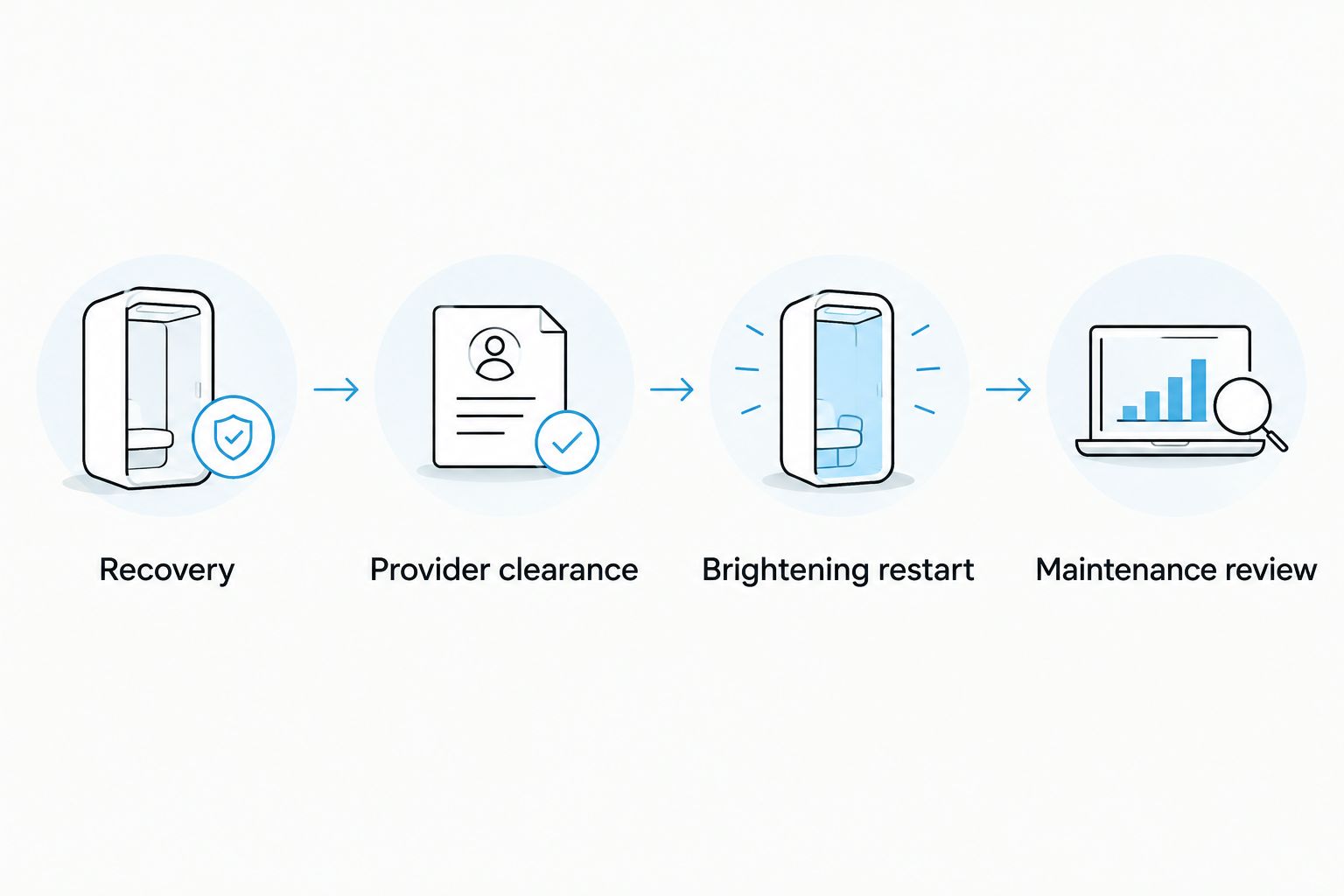
Toniqueskincare’s product category is relevant to the maintenance stage, but product names do not answer the aftercare question. Do not assume a brightening formula is suitable because it is sold for dark spots. Its complete ingredients and your skin’s condition determine the next discussion with your provider.
Your maintenance review
A routine needs a review loop, not an automatic increase in strength. Compare tolerance and pigmentation separately: a treatment that irritates your skin is not a successful maintenance plan simply because it creates visible exfoliation.
- Take consistent photographs. Use the same room, lighting, camera position, and facial angle. Avoid filters and photograph without makeup so coverage does not distort the comparison.
- Track symptoms separately. Record stinging, itching, dryness, and redness independently from spot color. This helps your clinician distinguish a pigmentation concern from an irritation problem.
- Check daily protection. Review sunscreen application, outdoor reapplication, shade, and activities that expose treated areas to sun. A treatment product cannot replace these habits.
- Review before escalating. Bring your photographs and product record to the agreed follow-up. Ask whether to continue, simplify, change treatment, or reassess the diagnosis.
Expected result: your next decision is based on comparable observations and professional assessment, not a flattering photograph or a stronger-sounding product name.
Use these workflow options to choose the appropriate stage of care in 2026:
| Workflow option | Best for | Benefit | Limitation | Next move |
|---|---|---|---|---|
| Recovery-only care | Skin still tender or reactive after treatment | Avoids adding treatment-related irritation | Does not actively target pigmentation with a dark spot product | Continue approved basics and confirm recovery with your provider |
| Approved brightening maintenance | Recovered skin with a reviewed formula | Adds targeted home care while keeping the routine controlled | Still requires tolerance checks and consistent sun protection | Restart the approved product as directed |
| Dermatologist reassessment | Worsening, unexplained, or persistent discoloration | Reviews the cause and treatment suitability | Requires clinical assessment rather than a self-directed routine change | Arrange an evaluation before stronger treatment |
Repeat the handoff whenever treatment changes
A second workflow applies when you book another session or the provider changes the procedure. Do not carry the previous restart plan across automatically.
Before the appointment, send your current product list and report any new sensitivity or darkening. Ask which products need a pause and whether the upcoming treatment differs from the last session. Keep the prescriber involved when prescription products are affected.
After the appointment, update the written plan and return to the approved recovery stage. Resume maintenance only under the new instructions. A previously tolerated product is not permission to ignore fresh aftercare restrictions.
This repeat-session workflow also applies if you have added an acne medication, developed a rash, or changed brightening formulas since the earlier appointment. The provider needs the current picture, not the routine you followed months ago.
Troubleshooting
Your usual moisturizer suddenly stings
Pause unapproved active products and contact the treating office for guidance on suitable basics. Do not repeatedly reapply a stinging formula to test whether your skin has adjusted. Persistent burning, swelling, or worsening redness needs clinical advice.
A dark spot looks darker after treatment
Do not scrub or peel it again. Irritation can contribute to post-inflammatory pigmentation, but a photograph alone cannot establish the cause. Send the provider a clear image and your product record; worsening discoloration deserves reassessment before another procedure.
You cannot identify which product caused irritation
Stop adding products and give the provider a complete list, including cleansers, pads, and occasional masks. A hidden exfoliant can be part of the problem. Once recovery is confirmed, restart only under an agreed plan that separates product changes.
Your routine pills under sunscreen
Keep sunscreen protection intact rather than reducing application to prevent pilling. Simplify the products underneath and follow their application directions. Save makeup experiments for recovered skin and ask the office about anything that requires repeated rubbing to remove.
Symptoms are more than mild sensitivity
Contact the treating clinician promptly for blistering, open skin, drainage, significant swelling, increasing pain, or spreading redness. Seek urgent medical care for severe symptoms, fever with worsening skin changes, or eye involvement. Trouble breathing or swelling of the lips or tongue requires emergency care.
Customize your workflow
Expand your routine only after the basic recovery-to-maintenance handoff works. First identify the remaining problem: new acne marks, recurring melasma, sun-related spots, or irritation from products. These concerns do not all need more exfoliation.
For Toniqueskincare shoppers, the useful next step is reviewing a complete routine with the provider, not adding several brightening products at once. Use the guide to build a full skin-brightening routine to organize product roles, then confirm which roles fit your aftercare plan.
Keep your 2026 maintenance plan focused on an even-looking complexion and comfortable skin. Ask your clinician about persistent marks rather than treating every brown patch as the same condition. A spot that changes shape, color, or size needs medical evaluation before cosmetic treatment.
FAQ
What is the best microdermabrasion to home skincare routine for dark spots?
The best starting routine is provider-approved gentle cleansing, moisturizing, and sun protection, followed by a cleared brightening treatment after recovery. The timing depends on your procedure, skin response, and the exact formula.
When can I restart my dark spot cream after microdermabrasion?
Restart your dark spot cream when your treating provider clears that specific formula. Do not use a fixed online waiting period to override tenderness, irritation, or written aftercare instructions.
Can I use Toniqueskincare products right after microdermabrasion?
Use a Toniqueskincare product immediately afterward only if your treating provider approves its full formula for recovery. A brightening product name does not establish post-procedure suitability.
Do I need sunscreen after an in-office microdermabrasion treatment?
Yes, sun protection is essential after microdermabrasion. Use a provider-approved broad-spectrum sunscreen with SPF 30 or higher, follow its directions, and combine it with shade and protective clothing.
Can microdermabrasion make dark spots worse?
Yes, irritation from a procedure can lead to post-inflammatory hyperpigmentation. Report worsening discoloration to your provider rather than adding scrubs, peels, or stronger brightening products.
Can I use a home microdermabrasion device between office treatments?
Do not add home microdermabrasion between office treatments without your provider’s approval. Extra mechanical exfoliation can add irritation and disrupt the agreed recovery plan.
Is microdermabrasion the same as dermabrasion?
No, microdermabrasion is a more superficial exfoliating procedure, while dermabrasion is deeper resurfacing. Confirm the procedure name because aftercare and recovery instructions differ.
Should I increase my brightening treatment if dark spots are not fading?
Do not increase treatment strength or frequency without reviewing the plan with your clinician. Persistent pigmentation needs a check of the diagnosis, product tolerance, and sun protection before escalation.
One last thing
The most useful aftercare instruction is a restart condition, not just a date. Before your next appointment, ask: what should my skin look and feel like before I resume this exact product?
Write down the answer. A comfortable, consistent routine is a better maintenance goal than reproducing the freshly exfoliated feeling at home.