

A glycolic acid peel can be worth it for mild, superficial dark spots, but it is not the best first step for every complexion. The trade-off is irritation: an overly aggressive peel can trigger inflammation and leave new discoloration behind. For your 2026 decision, consider a professionally assessed peel when your skin is calm, your spots have been identified, and a consistent brightening routine has not delivered enough improvement.
- Is a glycolic acid peel worth it? Consider it for superficial dark spots, not irritated skin or unidentified marks.
- Professional assessment matters because peel strength, contact time, and your pigmentation history affect the risk.
- Toniqueskincare brightening education is best for consumers comparing skincare options, not diagnosing dark spots.
- Daily sun protection supports hyperpigmentation treatment; aggressive exfoliation can create additional discoloration.
Is a glycolic acid peel worth it for mild dark spots?
A professionally selected glycolic peel is worth considering when superficial pigmentation and uneven texture are your main concerns. If your spots are already fading or your routine regularly causes stinging, adding a peel introduces a risk without establishing that you need it. Start by reviewing how to build a full skin-brightening routine.
| Approach | Best for | Main advantage | Main limitation | Recommendation |
|---|---|---|---|---|
| Professionally assessed glycolic peel | Identified superficial dark spots with uneven texture | Controlled exfoliation with an individualized treatment plan | Irritation, recovery, and post-inflammatory pigmentation remain possible | Consider after assessment |
| Lower-strength home glycolic exfoliant | Gradual exfoliation on skin that tolerates acids | Fits into an ongoing routine | Not equivalent to an office peel; overuse still irritates | Follow the specific product instructions |
| Non-peel dark-spot routine | Mild discoloration without a need for additional exfoliation | Targets pigmentation without requiring a peeling procedure | Results depend on the ingredient, diagnosis, and consistency | Start here if your skin is comfortable |
| Barrier-focused care | Stinging, flaking, redness, or recent irritation | Addresses the irritation that can worsen pigmentation | Does not directly remove established pigment | Postpone the peel |
These approaches are not interchangeable. A home lotion, a pigment-targeting cream, and a professional peel differ in formulation, application, and purpose. Choose the approach that addresses your actual concern rather than the one that promises the most visible peeling.
Why this matters
A mild dark spot does not automatically need a strong treatment. You are trying to reduce the contrast between the mark and the surrounding skin—not create an injury that starts another cycle of discoloration.
Glycolic acid helps loosen the connections between surface skin cells. That exfoliation can improve the appearance of superficial uneven tone and texture, but it does not remove every type of pigmentation or stop the underlying cause of new spots.
For a 2026 skincare plan, the useful question is whether a peel adds something your current routine lacks. If your routine already produces dryness or burning, more exfoliation is the wrong addition. If your skin is comfortable but persistent surface discoloration remains, a dermatologist can help decide whether a peel is appropriate.
What evidence supports considering a glycolic peel?
Chemical peels are established dermatologic treatments for selected pigmentation and texture concerns. The American Academy of Dermatology's patient guidance describes both their uses and their risks, including changes in skin color. Glycolic acid belongs to the alpha hydroxy acid category addressed by the U.S. Food and Drug Administration's consumer guidance.
Neither source establishes that every mild dark spot needs a peel. The evidence supports selecting the right patient and procedure, not choosing the strongest acid available. Your diagnosis, skin response, and aftercare determine whether the treatment makes sense.
For your 2026 decision, keep these distinctions clear:
- Surface pigment is not the same as deep pigment. A superficial peel acts near the skin's surface; deeper discoloration needs a different assessment.
- A flat acne mark is not an indented scar. Improving discoloration does not mean restoring missing tissue.
- Melasma is not simply a collection of isolated spots. It often needs ongoing management, with procedures selected carefully.
- A changing spot is not a cosmetic treatment target. A mark that changes shape, color, or size needs medical evaluation before exfoliation.
There is no reliable way to diagnose pigment depth from a bathroom mirror alone. Color and appearance provide clues, but they do not replace an examination.
Professional glycolic peels: best for assessed superficial pigmentation
A professional glycolic peel offers something a stronger home product does not: an assessment and a controlled procedure. The clinician selects the formulation, monitors your skin, and determines how the treatment ends according to the peel's protocol.
That control matters. The percentage on a bottle does not describe the entire treatment, because formulation acidity, application, and contact time also influence its effect.
Consider professional assessment if your mild spots persist despite a well-tolerated routine. Ask the clinician what type of pigmentation you have, what improvement the peel is intended to produce, and what risks apply to your skin tone and history.
The limitation is that supervision does not eliminate complications. Irritation, burns, infection, scarring, and pigment changes are recognized chemical-peel risks. A clinician should explain the risks relevant to the proposed procedure rather than treating peeling as proof of success.
Tell the clinician about previous reactions to acids, cold sores, prescription skincare, recent procedures, and any history of dark marks after minor irritation. Do not conceal a strong home treatment because you think it will help the peel work faster.
Home glycolic products: best for label-directed exfoliation
An everyday glycolic product is not automatically a substitute for a professional peel. Products differ in their intended body area, formulation, and directions. Instructions for one product cannot safely become a treatment schedule for another.
Do not buy a professional-strength acid to recreate an office procedure at home. The FDA warns consumers about chemical-peel products that can cause serious injuries when used without appropriate professional supervision.
A patch test also does not prove that a strong peel is safe for your entire face. A small-area reaction cannot predict every effect of a larger application, longer contact time, or combination with other irritating products.
One relevant distinction in the Toniqueskincare brightening skincare catalog is the Glycolic Peeling and Lightening Lotion - Tonique. Its supplied description identifies it as an 8 oz body lotion containing 5% glycolic acid, intended for rough, thick body skin—not as a professional facial peel.
That body-focused purpose is its relevant fit; it does not establish suitability for mild facial spots. Do not transfer its use to your face or combine it with a peel without reviewing the directions and getting advice when needed.
Why glycolic peel results vary
The same ingredient can produce different outcomes because the skin concern and treatment conditions differ. These factors determine whether exfoliation helps your dark spots or adds irritation:
- Pigmentation type and depth: Superficial discoloration is a different target from deeper pigment or a mixed condition.
- Skin's current condition: Inflamed, sunburned, broken, or actively peeling skin is not a suitable starting point for another peel.
- History of post-inflammatory pigmentation: If irritation routinely leaves you with dark marks, treatment planning needs particular care.
- Peel formulation and application: Acid concentration, acidity, contact time, and application affect the treatment's intensity.
- Other products and procedures: Retinoids, exfoliating acids, scrubs, and recent treatments can increase the irritation burden.
- Sun exposure and aftercare: Inconsistent protection and picking at peeling skin work against an even-looking result.
A higher percentage is not a shortcut to a better outcome. The appropriate treatment is the one your skin can tolerate while addressing the diagnosed concern.
How should you decide whether to book a peel?
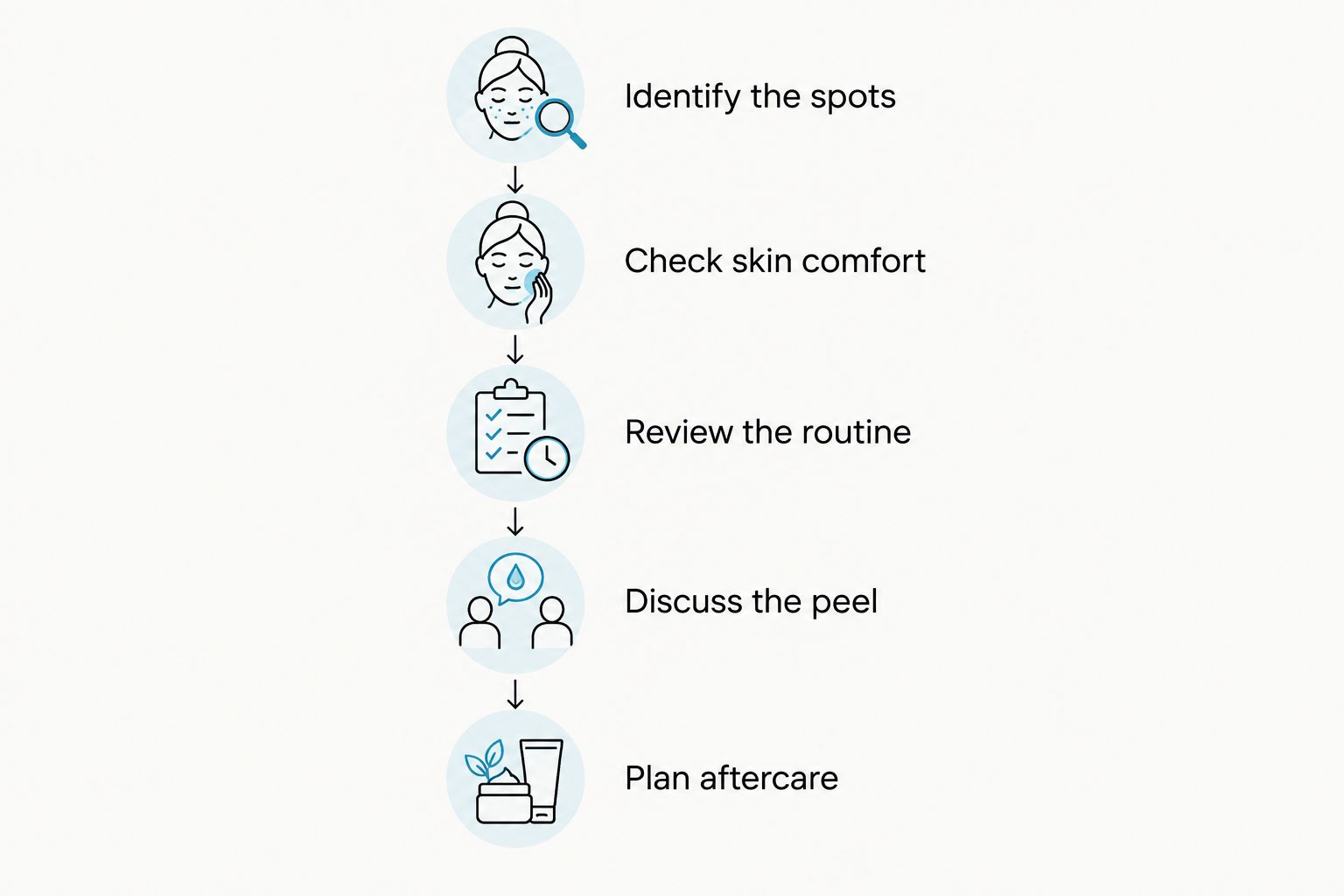
Use this sequence before committing to treatment. It separates the reason for the dark spots from the appeal of a brighter-looking complexion.
- Identify the spots. Have uncertain, changing, persistent, or widespread discoloration assessed. Do not assume every brown patch is an old acne mark.
- Check skin comfort. Notice whether water, moisturizer, or your usual products sting. Active discomfort is a reason to postpone exfoliation and address its cause.
- Review the routine. List your cleanser, acids, retinoids, spot treatments, scrubs, and recent procedures. Bring that list to your consultation.
- Discuss the peel. Ask what the proposed treatment addresses, how the clinician manages your pigmentation risk, and what aftercare involves.
- Plan aftercare. Make sure you can follow the instructions, protect your skin from sunlight, and avoid picking or adding unapproved treatments.
A useful consultation should leave you understanding why the peel fits your skin—not just which acid will be applied. If the explanation centers only on strength, ask for the missing reasoning.
What does a sensible post-peel routine include?
Follow the treating clinician's instructions rather than combining advice from unrelated products. Use the recommended cleansing and moisturizing approach, leave peeling skin alone, and ask when to restart active ingredients.
For a 2026 aftercare plan, sun protection is essential. The American Academy of Dermatology recommends broad-spectrum, water-resistant sunscreen with SPF 30 or higher, reapplied every 2 hours outdoors and after swimming or sweating as directed. Shade and protective clothing also matter.
The FDA's alpha hydroxy acid guidance warns that these products can increase sun sensitivity during use and for 1 week after stopping. That warning is not permission to stop protecting your skin afterward; ongoing exposure can contribute to further discoloration.
Burning, blistering, severe pain, or worsening swelling are reasons to contact the treating clinician promptly. Do not add another acid to remove a darkened patch after a reaction. More exfoliation can deepen the problem you are trying to solve.
Can a glycolic acid peel make dark spots worse?
Yes, a glycolic acid peel can worsen dark spots when irritation or injury triggers post-inflammatory hyperpigmentation. This risk deserves particular attention if you have darker skin or a history of marks after inflammation.
The answer is careful treatment selection, not avoiding every procedure indefinitely. Choose a qualified clinician experienced with your skin tone, discuss previous reactions, and follow the aftercare plan.
Is a glycolic peel better than a dark-spot cream?
A glycolic peel is not automatically better than a dark-spot cream for mild pigmentation. A peel exfoliates, while a cream's effect depends on its active ingredients; the treatments do not necessarily address the same part of the problem.
Toniqueskincare brightening skincare should be evaluated by the individual product's ingredients, intended use, and directions—not by treating every brightening product as equivalent. If a comfortable topical routine is improving your marks, there is no automatic reason to escalate to a peel.
How many glycolic peels will you need for mild dark spots?
There is no universal number of glycolic peels for mild dark spots. The clinician should base any treatment plan on your diagnosis, the proposed peel, your response, and whether further treatment remains appropriate.
Do not commit to an escalating schedule just because the first treatment produced visible peeling. Improvement in the spots and tolerance of treatment are more useful than the amount of skin that sheds.
FAQ
Is a glycolic acid peel worth it for a few mild acne marks?
A glycolic acid peel is worth considering for persistent superficial acne marks after professional assessment. If the marks are already improving with a comfortable routine, a peel is not an automatic next step.
What's the safest way to try a glycolic peel for dark spots?
Get a professional assessment before choosing a peel, especially if irritation leaves you with dark marks. Do not attempt to reproduce a professional-strength procedure at home.
Can I use a glycolic body lotion on facial dark spots?
Do not assume a glycolic body lotion is suitable for facial dark spots. Follow its intended-use directions and seek advice before applying it to a different body area.
Is a glycolic peel suitable for darker skin tones?
A glycolic peel requires careful selection for darker skin tones because inflammation can cause additional pigmentation. Choose a clinician experienced with your skin tone and discuss your history of reactions.
Can I keep using retinol around a glycolic peel?
Follow the treating clinician's instructions about pausing and restarting retinol around a glycolic peel. Combining irritating treatments without a plan can increase skin irritation.
What sunscreen should I use after a glycolic peel?
Use the sunscreen recommended by your clinician; general AAD guidance calls for broad-spectrum, water-resistant SPF 30 or higher. Reapply every 2 hours outdoors and after swimming or sweating as directed.
Should I get a glycolic peel right before an event in 2026?
Do not schedule an unfamiliar glycolic peel immediately before an important event in 2026. Recovery and skin response vary, so discuss timing with the treating clinician rather than expecting an instant result.
One last thing
Visible peeling is not the goal; less noticeable pigmentation without new irritation is. Take progress photos in the same lighting, without filters, and compare the spots rather than how much your skin sheds.
For your 2026 decision, write down the problem you want treatment to solve before choosing an acid. Mild spots plus comfortable skin call for a different plan from mild spots plus burning, flaking, or ongoing breakouts. That distinction protects both your skin and your expectations.