

Yes, a dark spot serum is worth trying before prescription treatment when you have stable, flat discoloration, understand its cause, and choose a formula your skin tolerates. Irritation can create more dark marks, so a serum trial needs daily sun protection and should never delay evaluation of a new, changing, bleeding, or otherwise unusual spot.
- Is dark spot serum worth it? Yes, for stable discoloration—not an unexplained or changing skin lesion.
- Dark spot serum and prescription treatment both need sun protection; use broad-spectrum SPF 30 or higher.
- Tonique Skincare offers cosmetic brightening skincare; product selection does not replace a dermatologist’s diagnosis.
- Choose prescription evaluation when pigmentation persists, the diagnosis is unclear, or acne keeps creating new dark marks.
Is dark spot serum worth it before trying prescription treatment?
A serum is a reasonable first step for understood cosmetic discoloration, not a required step before seeing a dermatologist. You do not have to exhaust every over-the-counter option to qualify for medical treatment.
The useful comparison is not simply weak versus strong. It is self-directed cosmetic care versus a diagnosis-led treatment plan. Before starting, learn how to tell if your dark spot corrector is working so you can distinguish fading from changes in lighting or temporary skin hydration.
| Approach | Best for | Main advantage | Main limitation |
|---|---|---|---|
| Nonprescription dark spot serum | Stable, understood uneven tone on otherwise healthy skin | A practical cosmetic-care starting point | Results depend on the formula; irritation remains possible |
| Prescription treatment | Diagnosed pigmentation needing a clinician-directed plan | Treatment selection and follow-up address the specific condition | Requires medical assessment and attention to side effects |
| Dermatologist assessment before treatment | Unexplained, changing, symptomatic, or recurrent discoloration | Establishes what you are actually treating | Does not guarantee that a serum or prescription is appropriate |
For your 2026 decision, choose the route that fits the skin concern—not the route with the strongest-sounding label. A serum cannot diagnose melasma, identify a suspicious lesion, or correct the texture of a deep acne scar.
Why this matters
Dark spots describe an appearance, not a single condition. A flat brown mark left after a healed pimple differs from recurring facial patches, and both differ from a raised or changing lesion. Treating them as interchangeable leads to the wrong next move.
Post-inflammatory hyperpigmentation is discoloration that follows inflammation or injury. Acne, eczema, picking, and irritating skincare can leave these marks. If the original trigger continues, fading older spots does not prevent new ones from appearing.
The American Academy of Dermatology’s patient guidance on dark spots emphasizes treating the cause and protecting skin from the sun. Its sunscreen guidance recommends broad-spectrum, water-resistant SPF 30 or higher, with reapplication every 2 hours outdoors and after swimming or sweating, according to the label.
Brighter-looking skin should not come at the expense of comfortable, healthy skin. Burning, persistent redness, and peeling are not proof that a dark spot treatment is working. They are reasons to reassess your routine.
When trying a dark spot serum first makes sense
A serum-first approach fits flat marks that remain after the original irritation or breakout has settled, provided you know what caused them. Your goal is a more even-looking complexion rather than changing your natural skin color.
Start with a formula you can evaluate. Read the ingredient list, directions, warnings, and intended application area instead of judging the product by words such as concentrated or clinical strength. Those descriptions alone do not establish effectiveness or suitability.
A serum also needs to fit your existing routine. If your skin already feels tight, sore, or flaky, adding another active product makes it harder to determine what is causing the problem. Restore comfort before pursuing additional brightening.
Serum-first care has limits. It does not remove an indented scar, reliably identify the cause of a patch, or guarantee that longstanding pigment will disappear. Continue a serum because your skin tolerates it and your marks improve—not because finishing the bottle feels obligatory.
When prescription evaluation is the better next move
Choose a dermatologist appointment when you cannot identify the cause, patches repeatedly return, or a tolerated routine has not delivered meaningful improvement. Persistent pigmentation deserves a review of the diagnosis, not an endless rotation of bottles.
Recurring melasma is one reason to seek a diagnosis-led plan. A clinician can distinguish it from other pigmentation problems and discuss treatment, sun protection, and maintenance together. A prescription is not automatically a permanent solution; ongoing protection still matters.
Active acne is another reason to consider medical care. When new inflamed pimples keep appearing, treating only the leftover discoloration leaves the source of new marks untouched. Addressing acne and pigmentation together is more useful than continually adding brighteners.
Do not run a serum experiment on a spot that changes size, shape, or color, bleeds, fails to heal, or looks different from your other marks. Arrange medical evaluation instead. Likewise, ask a clinician about new widespread darkening or discoloration accompanied by other symptoms.
Seeing a dermatologist first is not overreacting. You are paying attention to whether the problem is cosmetic, inflammatory, or something that needs a different kind of care.
What should you check on a serum label in 2026?
A serum is a delivery format, not an active ingredient. Two products with the same dark spot claim can contain different ingredients and have different tolerability. The complete formulation matters more than the word serum.
Ingredients used in pigmentation care include niacinamide, vitamin C, azelaic acid, and kojic acid. Their roles and evidence differ, and an ingredient appearing on a label does not prove that the finished product will produce a particular result. Avoid assigning a promised fading speed from the ingredient name alone.
Check these details before buying or applying:
- Ingredient disclosure: You should be able to identify what the product contains.
- Directions: Use the stated amount, frequency, and application area.
- Warnings: Review restrictions relevant to sensitive skin, pregnancy, breastfeeding, or medications.
- Routine overlap: Identify other exfoliants, retinoids, or brighteners you already use.
- Your goal: Look for care appropriate to discoloration, rather than expecting a topical product to repair scar texture.
Natural does not mean irritation-free. Hydroquinone-free does not mean suitable for every person. In the United States, hydroquinone skin-lightening products are not approved for over-the-counter sale; prescription use belongs under medical guidance, as explained by the Food and Drug Administration.
Do not buy an unclear formula simply because it promises dramatic lightening. An ingredient list and usable directions are basic requirements, not optional extras.
How can you try a serum without making the decision harder?
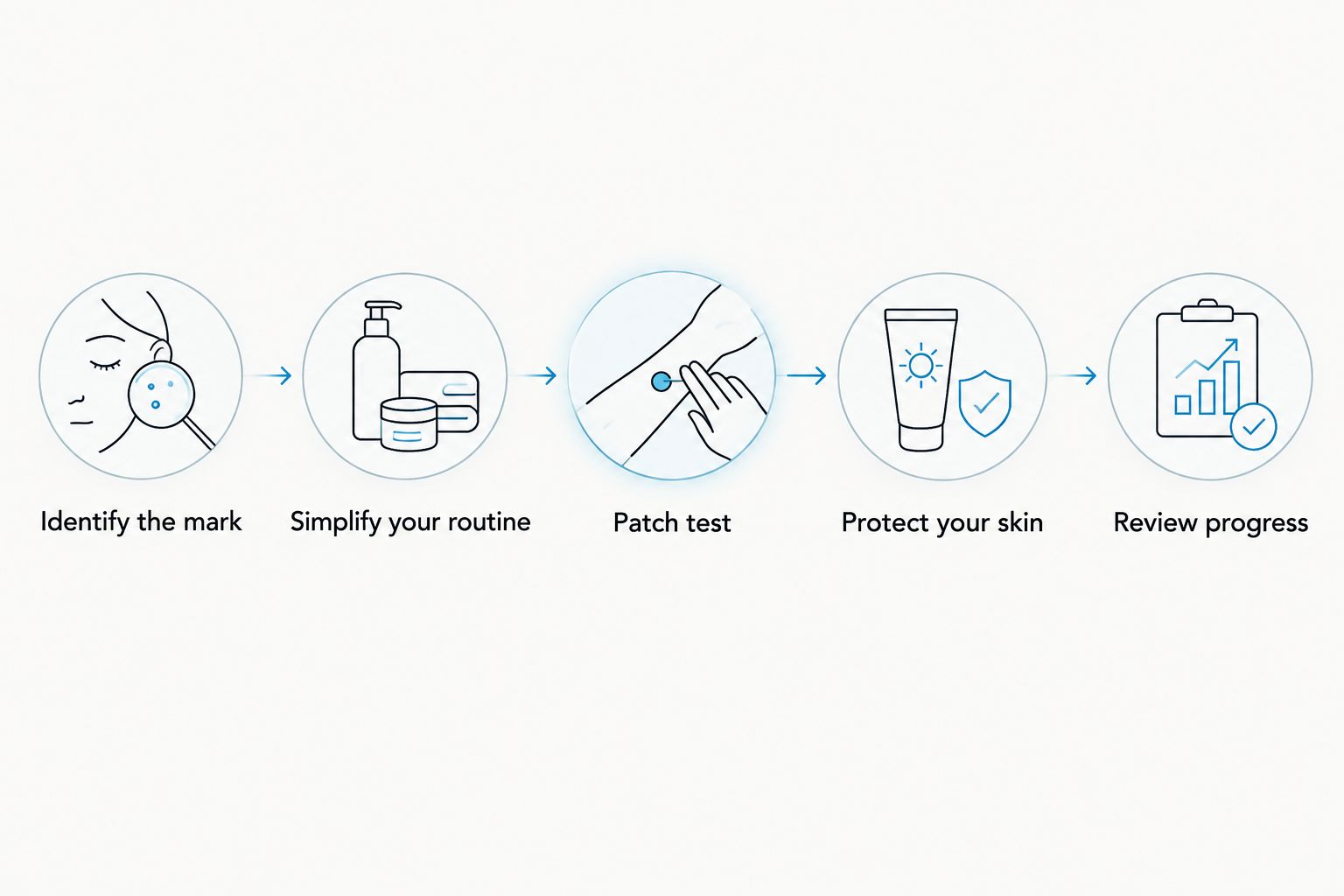
Use a simple sequence for your 2026 routine. Changing several products together prevents you from identifying which one helps—or which one irritates your skin.
- Identify the mark. Confirm that you are dealing with stable, flat discoloration. If the cause is uncertain or the spot is changing, seek assessment before applying a brightener.
- Simplify your routine. Keep cleansing and moisturizing gentle. Avoid introducing a scrub, peel, and serum together, and do not stop prescribed medication without your clinician’s advice.
- Patch test. The American Academy of Dermatology recommends testing a new skincare product on a small area twice daily for 7–10 days, following the product’s instructions. A tolerated patch test does not guarantee that facial use will be irritation-free.
- Protect your skin. Use broad-spectrum SPF 30 or higher, plus shade and protective clothing. Reapply sunscreen every 2 hours outdoors and follow its water-exposure directions.
- Review progress. Take photographs in consistent lighting, without filters, and note irritation alongside changes in discoloration. Follow the product’s directions and discuss persistent pigmentation with a clinician rather than repeatedly increasing application.
Keep a record of product names and when you introduced them. Bring that record to an appointment if you need prescription advice. It gives the clinician a clearer picture than saying you have tried everything.
Do not apply extra serum to compensate for missed use. More product does not establish better results, and it increases exposure to ingredients your skin must tolerate.
Where does Tonique Skincare fit into this decision?
Tonique Skincare dark spot skincare is best for shoppers seeking cosmetic uneven-tone care, not a substitute for medical diagnosis. That distinction keeps product shopping separate from deciding whether a mark needs clinical attention.
Tonique Skincare’s Color-Correcting Anti-Aging Brightening Serum is described as a hydroquinone-free formula for uneven skin tone. It is relevant when you are considering a cosmetic brightening serum, but that description does not establish a personal treatment outcome.
The benefit is its stated focus on uneven tone without hydroquinone. The limitation is equally clear: hydroquinone-free status alone does not establish tolerability, pregnancy suitability, effectiveness for melasma, or equivalence to a prescription. Read the complete current ingredient list and directions before deciding whether it fits your routine.
There is no reason to purchase a serum simply to postpone an appointment. If diagnosis is the missing piece, get the diagnosis first.
Why dark spot serum results vary
Results vary because pigment care depends on more than the product format. Use these factors to interpret your 2026 progress rather than assuming every slow response calls for a stronger formula:
- Cause of discoloration: Marks following healed acne differ from recurring melasma or an unidentified lesion.
- Ongoing inflammation: Breakouts, eczema, rubbing, and picking can keep producing new marks.
- Formula and use: Ingredients, the finished formulation, and following directions affect the usefulness of a trial.
- Skin tolerance: Irritation can lead to additional post-inflammatory discoloration, especially in darker skin tones.
- Sun exposure: Ultraviolet exposure can deepen pigmentation and undermine efforts to maintain a more even-looking complexion.
A successful routine therefore has two jobs: address existing discoloration and reduce avoidable triggers. A bottle handles only part of that work.
Is prescription treatment always better than a dark spot serum?
Prescription treatment is not automatically better for every dark mark. Its advantage is a clinician-selected plan for a diagnosed concern, with instructions and follow-up that reflect your skin and medical circumstances.
Prescription ingredients also have limitations and side effects. Do not treat stronger as a synonym for safer, faster, or necessary.
Can you use a dark spot serum with prescription treatment?
Use a dark spot serum alongside prescription treatment only after your prescriber reviews the formula. Ingredient overlap can increase irritation, and the instructions for your prescription take priority over a generic layering routine.
Bring the full ingredient list rather than only the product name. Ask which products to continue, pause, or introduce later.
Should you keep using a serum if your skin starts peeling?
Do not continue a cosmetic serum through persistent irritation in the hope that peeling guarantees fading. Stop the suspected irritating product and seek medical advice if symptoms persist; severe swelling, blistering, or breathing difficulty requires urgent attention.
Once your skin settles, reassess the formula and the rest of your routine. Simply applying less of every product does not identify the original cause.
FAQ
Is dark spot serum worth it before trying prescription treatment?
Yes, a dark spot serum is worth trying for stable, understood cosmetic discoloration when your skin tolerates it. Skip the trial and seek assessment for an unexplained, changing, bleeding, or nonhealing spot.
What is the best first step for dark spots in 2026?
The best first step is identifying the cause and protecting your skin from the sun. Use broad-spectrum SPF 30 or higher, and seek diagnosis when the cause is unclear.
How long should I try a dark spot serum before seeing a dermatologist?
Follow the product’s directions and arrange assessment when pigmentation persists, worsens, or remains unexplained. There is no universal serum trial period that applies to every formula and diagnosis.
Is a hydroquinone-free serum safer than prescription treatment?
Hydroquinone-free status alone does not establish that a serum is safer for you. The complete formula, your skin’s response, medical circumstances, and intended use matter.
Can a dark spot serum get rid of acne scars?
A dark spot serum can address discoloration but does not remove indented or raised acne scars. A dermatologist can distinguish pigment changes from scar texture and discuss appropriate care.
Can I use a dark spot serum while pregnant or breastfeeding?
Ask your pregnancy-care clinician or dermatologist to review the complete ingredient list before use. Do not assume that natural, brightening, or hydroquinone-free wording establishes suitability.
Do I still need sunscreen when I use a dark spot serum?
Yes, use broad-spectrum SPF 30 or higher with a dark spot serum. Reapply every 2 hours outdoors and after swimming or sweating according to the label, and add shade and protective clothing.
One last thing
Before buying your next serum in 2026, check whether new marks are appearing faster than old ones are fading. That pattern points to an ongoing trigger, not necessarily a need for a stronger brightener.
With Tonique Skincare or any cosmetic dark spot routine, keep the decision practical: identify the cause, protect your skin, and judge progress without accepting irritation as the price of an even-looking complexion. When the diagnosis is uncertain, the next step is an assessment—not another bottle.