

Instead of guessing when to use your LED mask and layering dark-spot products around it, follow this order: cleanse, use the device exactly as its instructions specify, then apply compatible skincare. LED light therapy skincare routine timing supports a repeatable routine; it does not establish that an LED mask will fade your dark spots.
- LED light therapy skincare routine timing starts with your device instructions, not a universal session length.
- Tonique Skincare brightening skincare belongs in the topical routine; compatibility with an LED device requires separate verification.
- Use LED before leave-on skincare when your device requires clean, dry skin.
- Dark-spot care needs daily sunscreen, tolerable topical treatment, and assessment of persistent or changing pigmentation.
Why this matters
Dark spots need more than a well-timed mask session. Sun exposure, ongoing acne, irritation, and conditions such as melasma can keep discoloration active even when you follow a skincare schedule consistently.
LED devices also serve different purposes. Evidence for treating acne or signs of skin aging does not automatically establish effectiveness for hyperpigmentation. A device marketed for clearer skin is not necessarily a treatment for existing brown marks.
For Tonique Skincare brightening skincare shoppers, LED is best treated as an optional addition, not the foundation of dark-spot care. The foundation is identifying the cause, avoiding irritation, and protecting your skin from sunlight.
If you are still choosing equipment for your 2026 routine, start with the guide to LED masks paired with a brightening routine. Read the device instructions before adding any treatment schedule.
Before you start
- Have the device instructions and required eye protection. Confirm the intended use, treatment area, session duration, frequency, cleaning method, and whether the manufacturer requires bare skin. Do not borrow settings from another mask.
- Check your skin and medication history. Ask your dermatologist or pharmacist about light sensitivity, eye conditions, medicines, and recent procedures before starting. Follow pregnancy-related restrictions in the device instructions and your clinician's advice.
- Check skincare compatibility before your first session. A tolerated serum is not automatically suitable underneath a light device. Have a gentle cleanser, moisturizer, sunscreen, and the full ingredient list and directions for any brightening treatment; leave unfamiliar acids, peels, and scrubs out of the initial setup.
The easily missed issue is treatment purpose. Blue-light acne treatment and pigment treatment are not interchangeable, and visible light can worsen pigmentation in susceptible skin, particularly darker skin tones. If you have melasma or light-triggered discoloration, get device-specific dermatology advice before using a light treatment.
Clean-skin preparation
Your first configuration task is deciding what belongs on your face before the session. The manufacturer's preparation instructions take priority over a generic skincare layering chart.
- Check the treatment area. Do not use the device over a new, changing, bleeding, or otherwise unexplained spot instead of getting it examined. Avoid treating actively irritated or broken skin without medical guidance.
- Remove makeup and sunscreen. Use a cleanser you already tolerate, following its directions. Add a makeup-removal step only when needed; repeated washing and scrubbing are not useful preparation.
- Prepare the skin as instructed. If the device requires clean, dry skin, pat dry and leave off toner, serum, oil, moisturizer, and sunscreen until afterward. Use a pretreatment product only when the device instructions explicitly permit it.
- Prepare the device. Clean its skin-contact surfaces using the manufacturer's method, check for damage, and position it as directed. Fit the specified eye protection before starting.
Expected result: your skin and equipment meet the device's preparation requirements, with no unverified product underneath the treatment surface.
Do not add exfoliation to make the light “penetrate better.” That creates another source of irritation without establishing a better pigment outcome. If cleansing alone leaves your skin stinging, postpone the session and address the irritation first.
Device schedule and session
Build the LED part of your 2026 routine around the actual equipment, not around a promised dark-spot deadline. Treatment time, intensity, distance, and frequency depend on the device; color alone does not tell you the correct dose.
- Confirm the intended treatment. Read which concern the device is designed to address. Do not select a mode simply because its color sounds associated with brightening.
- Follow the specified session duration. Use the manufacturer-directed program and positioning. If the instructions are unclear, contact the manufacturer before treating your skin.
- Follow the specified frequency. Put the permitted sessions in your calendar. Do not add extra sessions to compensate for a missed appointment or a spot that looks unchanged.
- Watch for discomfort. Stop for burning, painful heat, eye pain, or a concerning skin reaction. Do not treat these symptoms as evidence that the device is working.
- End the session as directed. Remove the device and eye protection according to its instructions, then inspect your skin before applying leave-on products.
Expected result: you complete the prescribed session without extending exposure or improvising settings. Record what you actually used so you can recognize a reaction or discuss the routine with a clinician.
A consumer mask is not equivalent to an in-office laser or intense pulsed light treatment. Do not copy recovery instructions or pigment expectations from those procedures into an LED schedule.
Post-session skincare
For devices that require bare skin, the practical sequence is Cleanse, LED session, Skincare, Sun protection. This places leave-on products after the light treatment without claiming that LED improves their absorption or effectiveness.
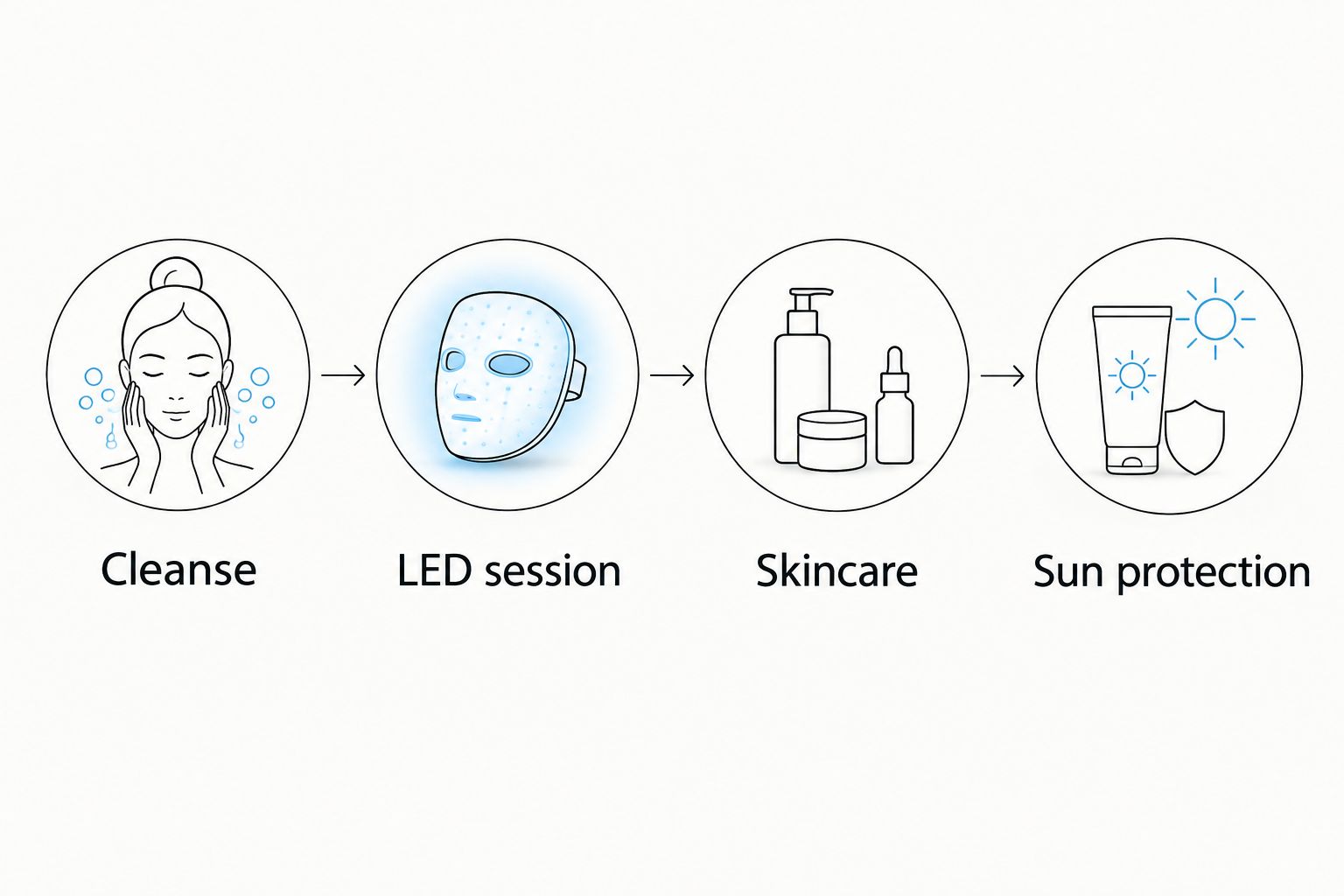
The order is simple, but product compatibility still matters. Apply a leave-on treatment only when your skin feels comfortable and both the product and device directions allow the combination.
- Check your skin first. If the session leaves persistent redness, tenderness, itching, or stinging, skip brightening actives and stop the device pending advice. Use only skincare you tolerate; do not cover a reaction with another treatment.
- Apply your established topical treatment. Follow its label or prescription instructions for amount, location, and frequency. Do not increase the amount because you have just used LED.
- Moisturize as needed. Follow the layering instructions for your treatment. A moisturizer supports skin comfort but does not make an incompatible combination safe.
- Finish daytime skincare with sunscreen. American Academy of Dermatology guidance recommends broad-spectrum, water-resistant sunscreen with SPF 30 or higher. Apply it 15 minutes before going outdoors and reapply every 2 hours outdoors, as well as after swimming or sweating according to the label.
Expected result: your topical routine remains within its own instructions, and daytime sun protection is in place. There is no universal waiting period after LED that makes every active ingredient compatible.
Tonique Skincare offers brightening skincare, but a product's brightening label does not establish that it can be paired with your particular device. Check the full formula and directions rather than assuming that all products in the category work together.
Progress records and maintenance
Your final setup task is making results interpretable. A 2026 progress record should distinguish existing spots, new breakouts, irritation, and changes in sun exposure rather than treating every color change as an LED result.
- Take a baseline photograph. Use consistent lighting, camera position, and an unfiltered image. Photograph the same area when you review progress; changing exposure or makeup can make comparison misleading.
- Keep a session record. Note the date, device mode, manufacturer-directed duration, and any symptoms. Record skipped sessions rather than doubling the next treatment.
- Record topical changes separately. Write down when you introduce, stop, or change a brightening product. Avoid changing several treatments at once, because you will not know which change caused irritation or improvement.
- Use the appropriate review point. Follow the device's stated assessment period and your topical treatment plan. Ask a dermatologist about persistent pigmentation rather than continually extending sessions.
Expected result: you can describe your routine accurately and compare your skin without relying on memory. Improvement still cannot be attributed to LED alone when sunscreen, topical treatment, or acne control changed at the same time.
For sustained improvement, keep addressing the original trigger. Do not stop sun protection when a spot looks lighter, and do not continue prescription pigment treatment indefinitely without following the prescriber's plan.
Morning LED versus evening LED
Morning and evening are both practical scheduling options when permitted by your device. Neither time of day is inherently a proven shortcut to darker spots fading faster.
| Workflow | Best for | Advantage | Limitation |
|---|---|---|---|
| Morning LED | People who consistently complete morning skincare | Treatment happens before daytime leave-on products and sunscreen | You need enough time to finish sun protection before going outdoors |
| Evening LED | People who prefer treating after removing makeup | Clean-skin preparation fits naturally after the day ends | Fatigue can lead to missed sessions; LED does not replace morning sunscreen |
| Separate-session routine | People using a clinician-directed topical schedule | Separates activities and makes the schedule easier to track | Separation does not resolve a true device, medication, or ingredient contraindication |
Choose the permitted schedule you can follow without rushing. The advantage is consistency, not a special morning or nighttime pigment effect.
Use LED in the morning instead
For a morning variant, cleanse and prepare your skin according to the manual, complete the session, then follow compatible skincare with sunscreen. Apply makeup after your sun-protection step according to the products' directions.
If you exercise afterward, account for sweating and sunscreen reapplication before outdoor exposure. Do not leave off sunscreen to preserve the feeling of freshly treated skin.
Keep brightening treatment separate
If your clinician recommends a topical treatment at a different time from LED, preserve that schedule. Complete the light session as directed and use the prescribed treatment at its assigned time.
Do not assume spacing treatments apart removes photosensitivity or another contraindication. If the device instructions exclude a medication or ingredient, ask the manufacturer and your clinician rather than inventing a waiting interval.
Troubleshooting your routine
Skincare pills after the session
Pilling is a layering problem, not proof that the light treatment failed. Follow each product's application directions, avoid unnecessary layers, and let products settle as directed before applying the next one.
Do not scrub away the residue and repeat LED. Review your skincare layers separately from the device schedule.
Your face stings or feels unusually hot
Stop the session and pause irritating skincare. Check the device's condition, fit, positioning, and permitted use; do not restart merely because the timer has not finished.
Seek medical advice for persistent pain, redness, or swelling. Blistering or eye symptoms need prompt assessment rather than a revised home schedule.
Dark patches look worse
Stop the light treatment and contact a dermatologist, especially if you have melasma or darker skin prone to pigment changes. Review recent irritation, sun exposure, new products, and the light mode you used.
Do not switch colors or increase exposure as a home correction. Worsening pigmentation needs an assessment of the cause.
You missed sessions
Resume only according to the manufacturer's schedule. Do not run back-to-back treatments or lengthen a session to catch up.
If sessions repeatedly conflict with your day, change the time slot—not the exposure instructions. A simpler permitted schedule beats an ambitious one you cannot maintain.
Spots remain despite consistent use
Confirm that the device is intended for your concern and that your topical plan addresses the diagnosis. Existing brown marks, active acne, and indented scars are different problems.
Do not answer an ineffective routine with more light. Get persistent pigmentation assessed, particularly when the spot's appearance or behavior changes.
Customize your workflow
Once the routine feels comfortable, expand it around your actual concern. Acne-related marks need control of new breakouts; melasma needs an appropriate pigment plan; irritation-related marks need the irritation addressed first.
Keep your 2026 Tonique Skincare routine focused rather than adding every brightening step at once. Use the guide to building a full skin-brightening routine to organize cleansing, treatment, moisturizing, and protection around the LED schedule.
Introduce changes individually and follow product-specific directions. A peel, scrub, or additional dark-spot corrector is not an automatic next step after a successful light session.
FAQ
Should I use LED light therapy before or after skincare?
Use LED before leave-on skincare when your device requires clean, dry skin. Follow any different preparation instructions supplied with your device; do not assume a serum is suitable underneath it.
What is the best LED light therapy skincare routine timing for dark spots?
The best timing is a manufacturer-permitted session that fits your routine without delaying sunscreen or conflicting with treatment instructions. Timing alone does not establish that LED will fade pigmentation.
How many minutes should I use an LED mask?
Use the session duration specified for your exact device and program. There is no universal duration that applies to every mask, and longer exposure is not a substitute for an effective dark-spot treatment plan.
Can I apply Tonique Skincare products after LED therapy?
Apply a Tonique Skincare product afterward only when its directions and your device instructions permit the combination and your skin is comfortable. Check the ingredient list and ask your clinician about prescription treatments or light-sensitivity concerns.
Is red light better than blue light for fading dark spots?
Do not choose a pigment treatment by light color alone. Blue-light acne treatment is not interchangeable with dark-spot treatment, and visible light can worsen pigmentation in susceptible skin; get device-specific advice for melasma.
Do I still need sunscreen if I use an LED mask at night?
Yes, nighttime LED does not replace daytime sunscreen. Use broad-spectrum, water-resistant SPF 30 or higher and follow application and reapplication guidance.
How long does LED take to fade hyperpigmentation?
There is no reliable universal fading timeline for consumer LED devices. Results depend on the diagnosis and treatment, and an acne or anti-aging claim does not establish effectiveness against existing pigmentation.
Should I stop LED if my dark spots become darker?
Stop the light treatment and seek dermatology advice if pigmentation worsens. Do not increase exposure or switch modes to correct the change without an assessment.
One last thing
A lighter-looking photograph is not always a lighter spot. Different lighting, camera exposure, and makeup can create an apparent improvement without a skin change.
For your 2026 Tonique Skincare progress record, keep photographs consistent and include skin comfort alongside appearance. A routine that repeatedly irritates your skin needs correction, even if it feels more active.