

Instead of remembering sunscreen only when your cheeks look darker, build a sunscreen reapplication routine for melasma around an outdoor timer and immediate reapplication after swimming, sweating, or toweling. This workflow connects your morning application, phone reminders, and a ready-to-use sunscreen kit without treating sunscreen as a cure for melasma.
- A sunscreen reapplication routine for melasma combines broad-spectrum sunscreen, outdoor reminders, shade, and a hat.
- Reapply sunscreen every 2 hours outdoors, and follow label instructions after swimming or sweating.
- Tinted sunscreen containing iron oxides adds visible-light protection relevant to melasma; check the ingredient list.
- Tonique Skincare offers brightening skincare; sunscreen reminders support protection, not guaranteed melasma prevention.
Why this matters
Sunscreen helps limit light-triggered melasma worsening; it does not guarantee that melasma will disappear or never return. Melasma involves more than sun exposure, including hormonal influences. A reminder fixes missed applications, not every cause of pigmentation.
For your 2026 routine, the American Academy of Dermatology's published patient guidance supports broad-spectrum, water-resistant sunscreen with SPF 30 or higher. Its melasma guidance also recommends tinted sunscreen containing iron oxides because visible light can worsen melasma, especially in darker skin tones. These are category recommendations, not verified specifications for an individual product.
Start with the criteria in Best Sunscreen for Melasma-Prone Skin, then build reminders around actual exposure.
Tonique Skincare is best suited to shoppers seeking brightening skincare, not a substitute for clinician-led melasma care. Keep those roles separate: skincare supports your cosmetic goals, while diagnosis and prescription treatment belong with your clinician.
Before you start
- Sunscreen and label access: Have broad-spectrum SPF 30 or higher sunscreen, its directions, and its ingredient list. For melasma, look for a suitable tinted formula containing iron oxides; choose water resistance for swimming or sweating.
- Phone and physical kit: This guide uses the iPhone Clock app. Keep sunscreen, a broad-brimmed hat, and clean application supplies where you leave home or begin outdoor work. No additional app account is required.
- The gotcha: A clock cannot detect sunscreen removed by water, sweat, or a towel. Reapply according to the label after those events, even when your timer has not finished; water-resistant does not mean waterproof.
Check the label on the sunscreen you actually use during your 2026 setup. Do not copy SPF, ingredients, or water-resistance claims from another product with a similar name.
Sunscreen selection and morning application
Choose the formula you can reapply properly
A melasma routine needs protection you will use in an adequate amount. A comfortable finish helps consistency, but cosmetic appeal does not replace broad-spectrum labeling or ingredient checks.
| Option | Best for | Advantage | Limitation |
|---|---|---|---|
| Tinted broad-spectrum SPF 30+ sunscreen containing iron oxides | Melasma-prone skin needing UV and visible-light protection | Combines UV protection with iron-oxide pigments relevant to visible light | Shade mismatch or an uncomfortable finish can make adequate application difficult |
| Untinted broad-spectrum SPF 30+ sunscreen | People who cannot tolerate a suitable tinted formula | Provides UV protection when applied as directed | Does not establish the visible-light protection associated with iron-oxide pigments |
| Tonique Skincare Tinted Brightening Sunscreen | Shoppers considering a tinted sunscreen within a brightening routine | Offers a named tinted sunscreen option | Confirm SPF, broad-spectrum labeling, iron oxides, and water resistance before selecting it for this workflow |
Choose by the label, not the word brightening. A tinted appearance alone does not verify iron oxides, and a sunscreen name does not establish its SPF or water resistance.
Set your morning application anchor
- Finish your usual skincare according to its directions. Let underlying layers settle rather than immediately rubbing everything together.
- Apply sunscreen generously and evenly to exposed skin, following the product label. Include frequently missed areas such as the ears, hairline, neck, and exposed chest.
- Apply sunscreen before outdoor exposure. American Academy of Dermatology guidance recommends application about 15 minutes before going outdoors.
- Add your hat and plan access to shade. Sunscreen is one layer of protection, not permission to stay in direct sunlight indefinitely.
- Put the sunscreen into your bag before leaving. A reminder without an accessible product cannot complete the task.
Expected result: You leave with sunscreen applied, the product available for reapplication, and a plan for physical protection. You have not started a timer merely because you woke up; the reminder will follow your outdoor exposure.
Outdoor timer configuration
Use an elapsed-time timer when your outdoor start time changes. This is the better fit for errands, walks, gardening, and variable work shifts because it follows the day's activity rather than a fixed schedule.
Configure your reapplication trigger
- After your sunscreen application, open Clock on your iPhone.
- Select Timers and set a duration of 2 hours for an outdoor reapplication reminder. Follow any more frequent instructions on your sunscreen label.
- Open When Timer Ends and choose an audible alert. Do not select Stop Playing, which is intended to stop media rather than provide your reapplication sound.
- Tap Start when beginning the outdoor block after your application. If substantial time has passed since application, reassess protection before going outside rather than assuming it is fresh.
- Keep the phone within hearing distance. Check the alert sound and volume before relying on it during a noisy shift or workout.
Expected result: The timer displays an active countdown, and its endpoint uses an audible alert. Your 2026 reminder now follows an outdoor block instead of sending irrelevant notifications throughout the night.
Test the alert while you are still at home using a short countdown, then restore the intended duration. The test confirms that you can hear the notification; it does not measure sunscreen effectiveness.
Connect the alert to an action
A timer is useful only when it leads to reapplication. Use the same response every time: move somewhere suitable, apply sunscreen, then restart the timer if outdoor exposure continues.
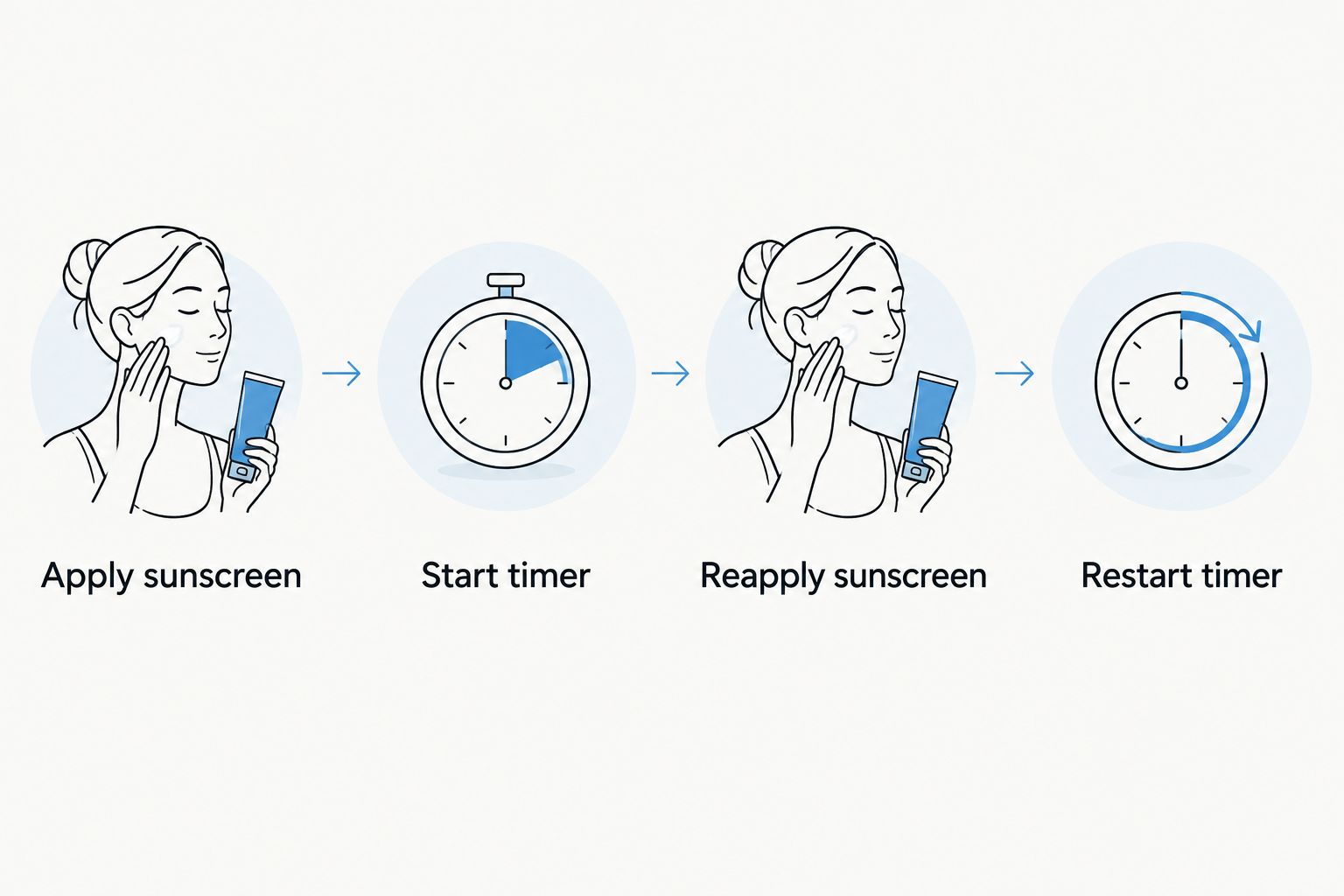
Keep the sunscreen beside the item you need for the activity: your work bag, walking shoes, or outdoor supplies. Avoid leaving it somewhere inaccessible when the reminder sounds, and store it according to the label rather than in a hot vehicle.
Reapplication and completion checks
Complete the protection task
- When the alert sounds, move into shade or another suitable place. Clean your hands before touching your face.
- If skin is wet or heavily sweaty, gently dry it as directed by the sunscreen label. Do not scrub melasma-prone skin to prepare for another layer.
- Reapply sunscreen generously and evenly over exposed areas. Follow the amount and method on the label; a few cosmetic dabs are not a substitute for adequate coverage.
- Recheck areas affected by wiping or friction, including around the mouth, nose, hairline, and neck. Avoid the eyes and follow product warnings.
- Restart timer only after application is complete if you will remain outdoors. Cancel it when the outdoor block ends, then reassess before your next outing.
Expected result: Sunscreen is back on the skin, missed areas have been checked, and the next reminder reflects a completed application. Dismissing an alert is not completion.
For your 2026 routine, keep event-triggered reapplication separate from the timer. Swimming, sweating, and toweling change the task immediately; you do not wait for a scheduled notification to address them.
FDA sunscreen labeling recognizes 40-minute and 80-minute water-resistance claims. Those describe tested performance during water exposure, not an all-day guarantee. Follow the particular label for swimming or sweating and reapply immediately after towel drying.
Second workflow: reminders for a predictable outdoor schedule
Use recurring alarms when your outdoor blocks occur at reliable times. Best for: a regular outdoor shift or scheduled activity. The advantage is less daily setup; the limitation is that alarms become inaccurate when your schedule changes.
Configure recurring alarms
- Open Clock, select Alarms, and tap +.
- Set an alarm for the next planned outdoor reapplication. Base it on your actual application time and the sunscreen label, not an arbitrary lunch break.
- Open Repeat and select the days that match that outdoor schedule.
- Open Label and enter an actionable instruction such as Reapply sunscreen outdoors. Choose an audible Sound, then tap Save.
- Add further alarms only for the period when outdoor exposure continues. Disable or edit them when a shift changes, an outing is canceled, or you spend the day indoors.
Expected result: The alarms list shows enabled reminders on the correct days with recognizable labels. Each alert points to a real protection task, not a permanent notification you learn to ignore.
| Reminder method | Best for | Advantage | Limitation |
|---|---|---|---|
| Elapsed-time timer | Variable outdoor start times | Tracks an interval from the day's application | Requires restarting after reapplication |
| Recurring alarms | Predictable outdoor schedules | Reduces repeated setup | Needs editing when timing changes |
| Event-triggered action | Swimming, sweating, or towel drying | Addresses removal before a timer finishes | Depends on recognizing the event and having sunscreen nearby |
Combine an appropriate reminder method with event-triggered action. Neither a timer nor an alarm replaces instructions for water exposure.
Troubleshooting
The timer ends, but you hear no alert
Check When Timer Ends for an audible sound rather than Stop Playing. Check volume, connected audio devices, and whether the phone is within hearing distance. Repeat the short test before depending on the setup outdoors.
You dismiss reminders because you are busy
Move sunscreen into the bag or station you can actually access during the activity. Arrange a safe application break rather than applying while driving or operating equipment. If you cannot reapply immediately, reduce exposure with shade and protective clothing until you can.
Sunscreen pills over your skincare
Reduce unnecessary layers underneath and allow each layer to settle. Do not solve pilling by deliberately underapplying sunscreen or mixing it with moisturizer. If the combination keeps failing, use a simpler compatible routine or ask a dermatologist for help choosing one.
Makeup makes reapplication awkward
Choose a sunscreen method you can apply in the labeled amount over your existing routine. If necessary, remove and redo makeup rather than relying on a light dusting of SPF powder. Makeup with SPF does not eliminate the need for proper sunscreen application.
Pigmentation worsens despite consistent reminders
Review sunscreen labeling, adequate coverage, exposure, and irritation before adding more brightening products. Seek a dermatologist's assessment for worsening or uncertain pigmentation; sunscreen reminders cannot confirm a melasma diagnosis or establish the right treatment.
Customize your workflow
Treat protection and treatment as separate tracks in your 2026 plan. The protection track covers sunscreen, reapplication, shade, and clothing. The treatment track follows your clinician's advice and the directions for any skincare you use.
Tonique Skincare brightening skincare belongs in that second track, not in place of sunscreen. Avoid adding several exfoliating or brightening products at once, particularly when your skin already feels irritated. A routine that burns or stings needs review, not a more aggressive application schedule.
Adjust the reminder to your situation:
- Outdoor work: Keep sunscreen accessible and align application breaks with safe work pauses.
- Driving: Consider daylight exposure through windows; do not handle your phone or apply products while the vehicle is moving.
- Swimming: Use a suitable water-resistant sunscreen and follow its water-exposure directions independently of the timer.
- Mostly indoors: Assess actual daylight exposure instead of assuming everyone needs the same all-day alarm schedule.
Record missed applications and the reason they happened. That tells you whether to change the reminder, move the product, or simplify your morning layers. It does not require guessing whether a darker-looking photograph proves treatment failure.
FAQ
How often should I reapply sunscreen if I have melasma?
Reapply sunscreen every 2 hours outdoors and follow the label after swimming or sweating; reapply immediately after towel drying. Use broad-spectrum SPF 30 or higher, and do not treat the timer as permission to ignore sunscreen removal.
Is tinted sunscreen better than untinted sunscreen for melasma?
Tinted sunscreen containing iron oxides adds visible-light protection relevant to melasma, alongside appropriate UV protection. Check for broad-spectrum SPF 30 or higher and inspect the ingredient list; tint alone does not confirm iron oxides.
Do I need a sunscreen timer every 2 hours when I am indoors?
An outdoor timer does not automatically mean everyone needs identical indoor reminders. Consider daylight exposure through windows, outdoor trips, product directions, and advice from your dermatologist.
Can sunscreen reminders prevent melasma completely?
No, sunscreen reminders cannot guarantee complete melasma prevention. They support consistent protection against light-related worsening, but melasma also has other influences and often requires ongoing management.
Can I reapply sunscreen over makeup?
You can reapply sunscreen over makeup if you can achieve adequate, even coverage using the product's directions. A cosmetic dusting of SPF powder is not a replacement for proper sunscreen application.
Does Tonique Skincare Tinted Brightening Sunscreen meet every melasma sunscreen requirement?
Confirm its current label before selecting it for a melasma routine. Check SPF, broad-spectrum labeling, iron oxides, and water resistance rather than assuming those specifications from the product name.
What should I do when sunscreen stings my skin?
Stop using the irritating product and ask a dermatologist about a suitable alternative. Use shade and protective clothing while arranging tolerated sun protection, and seek medical advice for persistent or severe symptoms.
One last thing
A completed sunscreen task ends with sunscreen on your skin, not a cleared notification. Place the product before you configure another alert. The simplest useful change is making reapplication physically possible when the reminder arrives.